Dynamic compaction — applied energy per plan area

Soil Improvement, Ground Improvement

By Foundation Design Example Library

250 Rank #83 Views 5,549
Workspace
QUICK ACCESS
Related engineering apps Cases & data

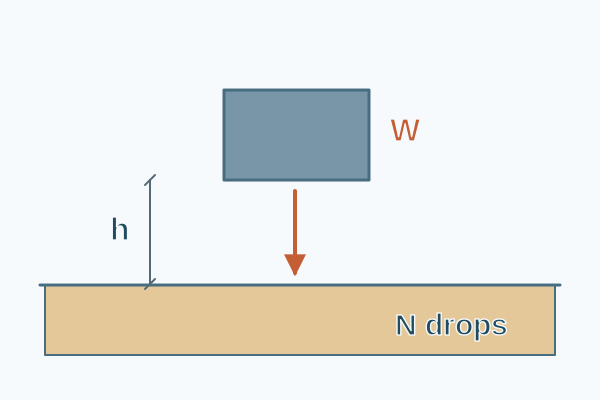
App-specific engineering geometry and parameter schematic

Theory and Method

\documentclass[11pt]{article} \usepackage{amsmath,amssymb,longtable,hyperref} \begin{document} \section{Dynamic compaction -- applied energy per plan area} \subsection{Application and idealization} Energy input index for preliminary dynamic-compaction planning. \subsection{Governing equations} $E_A=WN h/A$ using weight (kN). \subsection{Inputs, symbols and units} \begin{longtable}{p{0.16\linewidth}p{0.42\linewidth}p{0.12\linewidth}p{0.18\linewidth}} Symbol & Meaning & Unit & Default \\ W & Tamper weight (kN) & kN & 200 \\ h & Drop height (m) & m & 15 \\ N & Number of drops & - & 12 \\ A & Grid tributary area (m2) & m2 & 30 \\ \end{longtable} \subsection{Calculation procedure} Substitute the input values into the governing output equation. \begin{itemize} \item Nominal applied energy per unit area: \( \frac{W\,h\,N}{A} \). \end{itemize} \subsection{Worked example using default inputs} \begin{itemize} \item Nominal applied energy per unit area: 1200 kJ/m2. \end{itemize} \subsection{Assumptions and interpretation} Applied energy is not an empirical treatment-depth prediction or a compaction guarantee. \subsection{Accepted input ranges} \begin{itemize} \item Tamper weight (kN): 1 to 1000000 kN. \item Drop height (m): 0.1 to 100 m. \item Number of drops: 1 to 1000 -. \item Grid tributary area (m2): 0.1 to 1000000 m2. \end{itemize} \subsection{Reference and scope} FHWA Ground Improvement guidance and GEC No. 13 reference manuals. \url{https://www.fhwa.dot.gov/engineering/geotech/improvement/index.cfm} Ground modification concepts; the app covers the listed mechanism rather than a complete improvement design. \end{document}

Engineering Calculator

Engineering Calculation Results