Porosity from void ratio

Soil Improvement, Soil Phase Relations

By Foundation Design Example Library

311 Rank #51 Views 4,729
Workspace
QUICK ACCESS
Related engineering apps Cases & data

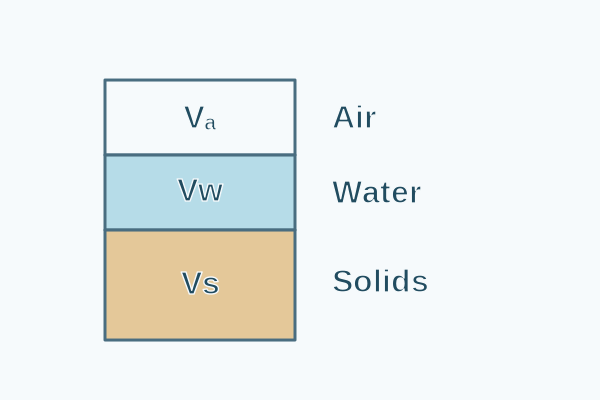
App-specific engineering geometry and parameter schematic

Theory and Method

\documentclass[11pt]{article} \usepackage{amsmath,amssymb,longtable,hyperref} \begin{document} \section{Porosity from void ratio} \subsection{Application and idealization} Two-phase volume relation. \subsection{Governing equations} $n=e/(1+e)$. \subsection{Inputs, symbols and units} \begin{longtable}{p{0.16\linewidth}p{0.42\linewidth}p{0.12\linewidth}p{0.18\linewidth}} Symbol & Meaning & Unit & Default \\ e0 & Void ratio (-) & - & 0.7 \\ \end{longtable} \subsection{Calculation procedure} Substitute the input values into the governing output equation. \begin{itemize} \item Porosity: \( \frac{\mathrm{e0}}{1+\mathrm{e0}} \). \item Porosity: \( \frac{100\,\mathrm{e0}}{1+\mathrm{e0}} \). \end{itemize} \subsection{Worked example using default inputs} \begin{itemize} \item Porosity: 0.41176471. \item Porosity: 41.176471 \%. \end{itemize} \subsection{Assumptions and interpretation} Index property only; does not predict hydraulic permeability. \subsection{Accepted input ranges} \begin{itemize} \item Void ratio (-): 0.01 to 5 -. \end{itemize} \subsection{Reference and scope} FHWA NHI-06-088, Soils and Foundations Reference Manual, Volume I (2006). \url{https://rosap.ntl.bts.gov/view/dot/41551} Background for soil properties, stress, strength, seepage and settlement; this tool implements only the equations stated here. \end{document}

Engineering Calculator

Engineering Calculation Results