Rankine passive lateral earth-pressure coefficient

Earth Retaining Structures, Earth Pressure Prediction

By Foundation Design Example Library

239 Rank #89 Views 5,776
Workspace
QUICK ACCESS
Related engineering apps Cases & data

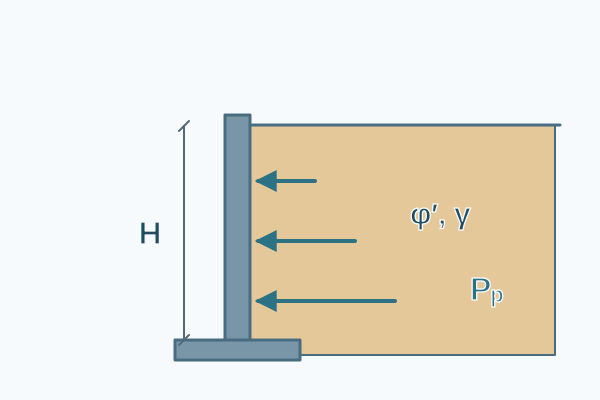
App-specific engineering geometry and parameter schematic

Theory and Method

\documentclass[11pt]{article} \usepackage{amsmath,amssymb,longtable,hyperref} \begin{document} \section{Rankine passive lateral earth-pressure coefficient} \subsection{Application and idealization} Idealized passive stress state for smooth vertical retaining structure. \subsection{Governing equations} $K_p=\tan^2(45^\circ+\phi^{\prime}/2)$. \subsection{Inputs, symbols and units} \begin{longtable}{p{0.16\linewidth}p{0.42\linewidth}p{0.12\linewidth}p{0.18\linewidth}} Symbol & Meaning & Unit & Default \\ phi & Effective friction angle (degrees) & deg & 30 \\ \end{longtable} \subsection{Calculation procedure} \[ \mathrm{Kp} = \operatorname{tan}\left(\frac{\left(45+\frac{\phi}{2}\right)\,\pi}{180}\right)^{2} \] \begin{itemize} \item Passive coefficient Kp: \( \mathrm{Kp} \). \end{itemize} \subsection{Worked example using default inputs} \begin{itemize} \item Passive coefficient Kp: 3. \end{itemize} \subsection{Assumptions and interpretation} Full passive resistance requires considerable wall displacement; design often reduces Kp. \subsection{Accepted input ranges} \begin{itemize} \item Effective friction angle (degrees): 1 to 48 deg. \end{itemize} \subsection{Reference and scope} FHWA NHI-06-089, Soils and Foundations Reference Manual, Volume II (2006). \url{https://rosap.ntl.bts.gov/view/dot/53656} Foundation and retaining-system background. Project-specific factors and complete design checks remain separate. \end{document}

Engineering Calculator

Engineering Calculation Results