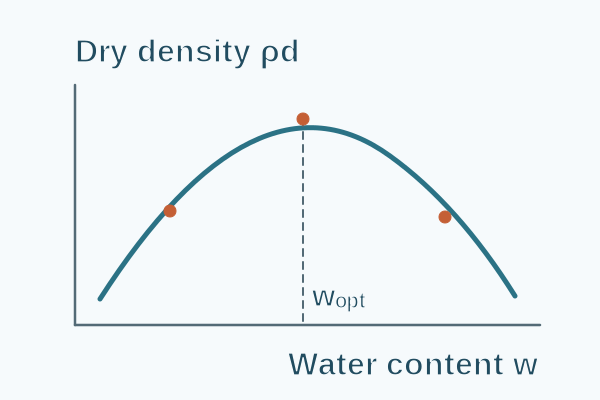
Relative compaction to maximum dry density

Soil Improvement, Compaction

By Foundation Design Example Library

350 Rank #33 Views 7,747
Workspace
QUICK ACCESS
Related engineering apps Cases & data

App-specific engineering geometry and parameter schematic

Theory and Method

\documentclass[11pt]{article} \usepackage{amsmath,amssymb,longtable,hyperref} \begin{document} \section{Relative compaction to maximum dry density} \subsection{Application and idealization} Field-to-laboratory dry density ratio. \subsection{Governing equations} $R_c=100\gamma_{d,field}/\gamma_{d,max}$. \subsection{Inputs, symbols and units} \begin{longtable}{p{0.16\linewidth}p{0.42\linewidth}p{0.12\linewidth}p{0.18\linewidth}} Symbol & Meaning & Unit & Default \\ gd & Field dry unit weight (kN/m3) & kN/m3 & 17 \\ gdmax & Lab maximum dry unit weight (kN/m3) & kN/m3 & 19 \\ \end{longtable} \subsection{Calculation procedure} Substitute the input values into the governing output equation. \begin{itemize} \item Relative compaction: \( \frac{100\,\mathrm{gd}}{\mathrm{gdmax}} \). \end{itemize} \subsection{Worked example using default inputs} \begin{itemize} \item Relative compaction: 89.473684 \%. \end{itemize} \subsection{Assumptions and interpretation} Test procedures, effort and soil type must be comparable. \subsection{Accepted input ranges} \begin{itemize} \item Field dry unit weight (kN/m3): 1 to 35 kN/m3. \item Lab maximum dry unit weight (kN/m3): 1 to 35 kN/m3. \end{itemize} \subsection{Reference and scope} FHWA Ground Improvement guidance and GEC No. 13 reference manuals. \url{https://www.fhwa.dot.gov/engineering/geotech/improvement/index.cfm} Ground modification concepts; the app covers the listed mechanism rather than a complete improvement design. \end{document}

Engineering Calculator

Engineering Calculation Results