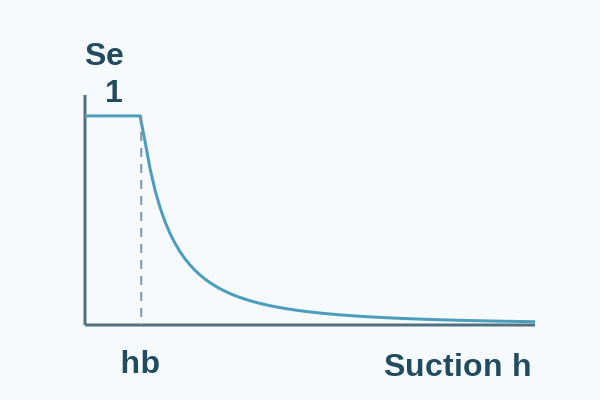
Brooks–Corey — air-entry retention and permeability

Groundwater & Seepage, Unsaturated Soil Hydraulics

By Foundation Design Method Library

265 Rank #74 Views 3,718
Workspace
QUICK ACCESS
Related engineering apps Cases & data

App-specific engineering geometry and parameter schematic

Theory and Method

\documentclass[11pt]{article} \usepackage{amsmath,amssymb,geometry,xurl,hyperref} \geometry{margin=0.85in} \setlength{\emergencystretch}{3em} \begin{document} \section{Brooks-Corey - air-entry retention and permeability} \subsection{Purpose} Represent an explicit air-entry threshold with the Brooks-Corey model. Below the air-entry suction the idealized material stays saturated; above it, water retention follows a power law. \subsection{Method and governing equations} \[ S_e=\begin{cases}1&h\leq h_b\\(h_b/h)^\lambda&h>h_b\end{cases} \] \[ \theta=\theta_r+(\theta_s-\theta_r)S_e,\qquad K_r=S_e^{3+2/\lambda},\quad K=K_sK_r \] \subsection{Inputs, symbols and units} \begin{itemize} \item \textbf{Positive suction-head magnitude} ($\mathtt{h}$): m. Default 4. \item \textbf{Air-entry suction head} ($\mathtt{hb}$): m. Default 1. \item \textbf{Pore-size distribution index lambda} ($\mathtt{lam}$): -. Default 2. \item \textbf{Residual volumetric water content} ($\mathtt{theta\_r}$): m3/m3. Default 0.05. \item \textbf{Saturated volumetric water content} ($\mathtt{theta\_s}$): m3/m3. Default 0.45. \item \textbf{Saturated hydraulic conductivity} ($\mathtt{Ks}$): m/s. Default 0.00001. \end{itemize} \subsection{Interpreting the results} Use this model where an air-entry plateau and power-law drainage tail are a suitable description. Compare the curve with laboratory observations before using its conductivity in a flow analysis. \subsection{Worked default example} \begin{itemize} \item Effective saturation: 0.0625 -. \item Volumetric water content: 0.075 m3/m3. \item Relative wetting-phase permeability: 0.00001525878906 -. \item Hydraulic conductivity: 1.525878906e-10 m/s. \end{itemize} \subsection{Verification example} The stored benchmark is an independently evaluated identity or worked numerical case, not a value copied from the runtime output. The verification case uses the default inputs listed above. Expected benchmark quantities: \begin{itemize} \item Effective saturation: 0.0625. \item Volumetric water content: 0.075. \item Relative wetting-phase permeability: 0.00001525878906. \end{itemize} \subsection{Assumptions and limits} This is the original wetting-phase permeability form, not a Brooks-Corey retention curve combined with a different conductivity closure. Fit hb and lambda to the relevant drainage data. Hysteresis, residual-water mobility and preferential flow are outside the model. \subsection{References} Brooks and Corey (1964), Hydraulic Properties of Porous Media, Hydrology Paper 3. Effective saturation, bubbling pressure and wetting-phase relative permeability. \url{https://www.wipp.energy.gov/information_repository/cra/cra-2014/references/Others/Brooks_Corey_1964_Hydraulic_Properties_ERMS241117.pdf} Original Brooks-Corey retention and permeability parameterization, with an explicit air-entry branch. \end{document}

Engineering Calculator

Engineering Calculation Results