CPTu — calibrated undrained shear strength

Laboratory & Site Characterization, Cone Penetration

By Foundation Design Method Library

129 Rank #137 Views 3,112
Workspace
QUICK ACCESS
Related engineering apps Cases & data

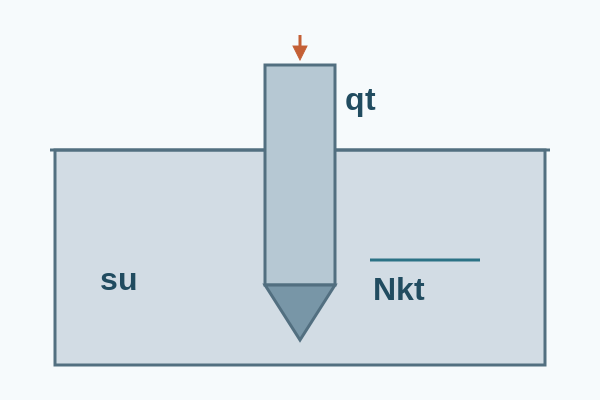
App-specific engineering geometry and parameter schematic

Theory and Method

\documentclass[11pt]{article} \usepackage{amsmath,amssymb,geometry,xurl,hyperref} \geometry{margin=0.85in} \setlength{\emergencystretch}{3em} \begin{document} \section{CPTu - calibrated undrained shear strength} \subsection{Purpose} Estimate undrained shear strength in a saturated fine-grained stratum using a locally calibrated CPTu cone factor. A user-supplied factor range makes the sensitivity of the transformation visible. \subsection{Method and governing equations} \[ s_u=\frac{q_t-\sigma_{v0}}{N_{kt}},\qquad s_{u,\min}=\frac{q_t-\sigma_{v0}}{N_{kt,\max}} \] \subsection{Inputs, symbols and units} \begin{itemize} \item \textbf{Corrected cone tip resistance qt} ($\mathtt{qt}$): MPa. Default 1.1. \item \textbf{Total vertical overburden stress} ($\mathtt{sigv}$): kPa. Default 100. \item \textbf{Selected site-specific cone factor} ($\mathtt{Nkt}$): -. Default 15. \item \textbf{Lower cone factor for sensitivity} ($\mathtt{Nlow}$): -. Default 10. \item \textbf{Upper cone factor for sensitivity} ($\mathtt{Nhigh}$): -. Default 20. \end{itemize} \subsection{Interpreting the results} Calibrate the factor against suitable high-quality laboratory or field strengths at the site, and preserve the intended loading mode. Use the broad range to test design sensitivity before selecting a characteristic strength. \subsection{Worked default example} \begin{itemize} \item Estimated undrained shear strength: 66.66666667 kPa. \item Lower strength for supplied factor range: 50 kPa. \item Upper strength for supplied factor range: 100 kPa. \item Net cone resistance: 1000 kPa. \end{itemize} \subsection{Verification example} The stored benchmark is an independently evaluated identity or worked numerical case, not a value copied from the runtime output. The verification case changes the following default inputs; all other inputs retain the defaults listed above. \begin{itemize} \item $\mathtt{Nkt}=20$: -. \end{itemize} Expected benchmark quantities: \begin{itemize} \item Estimated undrained shear strength: 50. \item Lower strength for supplied factor range: 50. \item Upper strength for supplied factor range: 100. \item Net cone resistance: 1000. \end{itemize} \subsection{Assumptions and limits} The test should be undrained and qt must already include the pore-pressure/area correction. Nkt depends on soil, stress history, loading mode and reference strength. The range is a sensitivity interval, not a statistical confidence interval. Partially drained silts, sands, thin layers, anisotropy and strongly structured deposits may invalidate the transformation. \subsection{References} FHWA GEC 5, Geotechnical Site Characterization (2016). FHWA GEC 5, section 7.5.2, equation 7.13 and discussion of site-specific Nkt.. \url{https://highways.dot.gov/sites/fhwa.dot.gov/files/FHWA-NHI-16-072.pdf} Data reduction and explicitly calibrated correlations; these tools do not replace soil sampling, local validation or a complete site investigation. \end{document}

Engineering Calculator

Engineering Calculation Results