Flat dilatometer — material, stress and modulus indices

Laboratory & Site Characterization, Dilatometer and Pressuremeter

By Foundation Design Method Library

155 Rank #126 Views 3,470
Workspace
QUICK ACCESS
Related engineering apps Cases & data

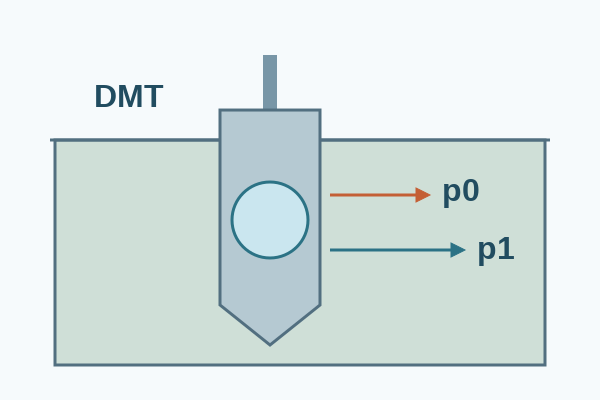
App-specific engineering geometry and parameter schematic

Theory and Method

\documentclass[11pt]{article} \usepackage{amsmath,amssymb,geometry,xurl,hyperref} \geometry{margin=0.85in} \setlength{\emergencystretch}{3em} \begin{document} \section{Flat dilatometer - material, stress and modulus indices} \subsection{Purpose} Reduce calibrated flat-dilatometer pressures to the three basic interpretation indices. The material index describes relative membrane response, the horizontal stress index normalizes lift-off stress, and ED is the dilatometer modulus. \subsection{Method and governing equations} \[ I_D=\frac{p_1-p_0}{p_0-u_0},\qquad K_D=\frac{p_0-u_0}{\sigma'_{v0}},\qquad E_D=34.7(p_1-p_0) \] \subsection{Inputs, symbols and units} \begin{itemize} \item \textbf{Corrected membrane lift-off pressure p0} ($\mathtt{p0}$): kPa. Default 100. \item \textbf{Corrected 1.1 mm expansion pressure p1} ($\mathtt{p1}$): kPa. Default 200. \item \textbf{Equilibrium pore-water pressure} ($\mathtt{u0}$): kPa. Default 0. \item \textbf{Effective vertical overburden stress} ($\mathtt{sigve}$): kPa. Default 50. \end{itemize} \subsection{Interpreting the results} Keep the three indices with the measured depth profile and sampling evidence. They are the starting quantities for a selected DMT interpretation procedure, not three interchangeable soil properties. \subsection{Worked default example} \begin{itemize} \item DMT material index ID: 1 -. \item DMT horizontal stress index KD: 2 -. \item Dilatometer modulus ED: 3470 kPa. \end{itemize} \subsection{Verification example} The stored benchmark is an independently evaluated identity or worked numerical case, not a value copied from the runtime output. The verification case uses the default inputs listed above. Expected benchmark quantities: \begin{itemize} \item DMT material index ID: 1. \item DMT horizontal stress index KD: 2. \item Dilatometer modulus ED: 3470. \end{itemize} \subsection{Assumptions and limits} p0 and p1 must already include membrane stiffness, gauge and other applicable corrections. KD is not the in-situ earth-pressure coefficient K0. ED is not Young's modulus and must not be inserted directly into an elastic settlement expression without a justified interpretation. Soil classification, OCR and constrained modulus correlations require additional choices and validation. \subsection{References} FHWA GEC 5, Geotechnical Site Characterization (2016). FHWA GEC 5, sections 4.17.3 and 6.12.2; equation 6.14 and equation 8.21.. \url{https://highways.dot.gov/sites/fhwa.dot.gov/files/FHWA-NHI-16-072.pdf} Data reduction and explicitly calibrated correlations; these tools do not replace soil sampling, local validation or a complete site investigation. \end{document}

Engineering Calculator

Engineering Calculation Results