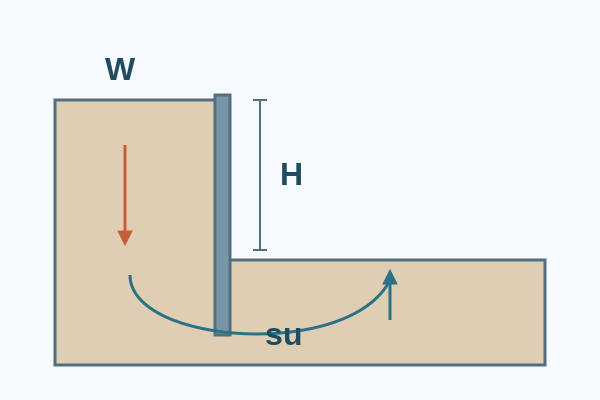
Wide excavation — undrained basal heave screen

Earth Retaining Structures, Excavation Base Stability

By Foundation Design Method Library

164 Rank #121 Views 3,978
Workspace
QUICK ACCESS
Related engineering apps Cases & data

App-specific engineering geometry and parameter schematic

Theory and Method

\documentclass[11pt]{article} \usepackage{amsmath,amssymb,geometry,xurl,hyperref} \geometry{margin=0.85in} \setlength{\emergencystretch}{3em} \begin{document} \section{Wide excavation - undrained basal heave screen} \subsection{Purpose} Screen undrained base instability using the wide, long-excavation limiting bearing mechanism. Retained-ground weight and surcharge drive movement into the excavation, resisted by undrained soil beneath its base. \subsection{Method and governing equations} \[ FS_{\mathrm{BH}}=\frac{N_cs_u}{\gamma H+q},\qquad N_c=5.14 \] \[ H_{\mathrm{target}}=\max\left[0,\frac{N_cs_u/FS_{\mathrm{target}}-q}{\gamma}\right] \] \subsection{Inputs, symbols and units} \begin{itemize} \item \textbf{Excavation depth} ($\mathtt{H}$): m. Default 6. \item \textbf{Retained soil total unit weight} ($\mathtt{gamma}$): kN/m3. Default 18. \item \textbf{Uniform retained-ground surcharge} ($\mathtt{q}$): kPa. Default 20. \item \textbf{Undrained shear strength below excavation} ($\mathtt{su}$): kPa. Default 40. \item \textbf{Project-selected target force ratio} ($\mathtt{FSreq}$): -. Default 1.5. \end{itemize} \subsection{Interpreting the results} Use the result to identify a basal mechanism that warrants detailed checking and construction-stage control. A satisfactory scalar ratio does not establish acceptable wall movements or support loads. \subsection{Worked default example} \begin{itemize} \item Undrained basal-heave force ratio: 1.60625 -. \item Applied overburden and surcharge stress: 128 kPa. \item Idealized basal resistance: 205.6 kPa. \item Depth matching supplied target ratio: 6.503703704 m. \item Excavation stability number: 3.2 -. \end{itemize} \subsection{Verification example} The stored benchmark is an independently evaluated identity or worked numerical case, not a value copied from the runtime output. The verification case changes the following default inputs; all other inputs retain the defaults listed above. \begin{itemize} \item $\mathtt{H}=5$: m. \item $\mathtt{gamma}=20$: kN/m3. \item $\mathtt{q}=0$: kPa. \item $\mathtt{su}=50$: kPa. \item $\mathtt{FSreq}=2$: -. \end{itemize} Expected benchmark quantities: \begin{itemize} \item Undrained basal-heave force ratio: 2.57. \item Applied overburden and surcharge stress: 100. \item Idealized basal resistance: 257. \item Depth matching supplied target ratio: 6.425. \item Excavation stability number: 2. \end{itemize} \subsection{Assumptions and limits} Nc = 5.14 represents the limiting wide and long geometry discussed in FHWA; favorable side shear is disregarded. The strength must represent the weak soil participating in the mechanism. Finite excavation geometry, a nearby stiff base, anisotropic strength, a floating wall toe, construction sequence and support-system interaction require a more complete analysis. The selected target ratio is an input, not a code-prescribed default. This is not hydraulic boiling. \subsection{References} FHWA GEC 7, Soil Nail Walls Reference Manual (2015). FHWA Soil Nail Walls Reference Manual, section 5.6.6 and equations 5.14-5.16, wide and long excavation limit.. \url{https://www.fhwa.dot.gov/engineering/geotech/pubs/nhi14007.pdf} Unfactored undrained idealization disregarding side shear; it is not a complete braced-excavation design. \end{document}

Engineering Calculator

Engineering Calculation Results