Eccentric footing — compression-only contact

Shallow Foundation, Contact Pressure

By Foundation Design Method Library

271 Rank #70 Views 4,628
Workspace
QUICK ACCESS
Related engineering apps Cases & data

App-specific engineering geometry and parameter schematic

Theory and Method

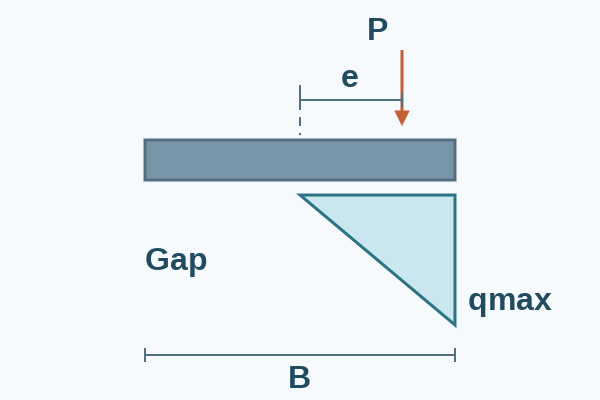
\documentclass[11pt]{article} \usepackage{amsmath,amssymb,geometry,xurl,hyperref} \geometry{margin=0.85in} \setlength{\emergencystretch}{3em} \begin{document} \section{Eccentric footing - compression-only contact} \subsection{Purpose} Continue a uniaxial footing contact-pressure calculation beyond the middle-third kern by enforcing zero soil tension. Full contact gives a linear trapezoid; partial contact gives a triangular compression zone that equilibrates the vertical load and moment. \subsection{Method and governing equations} \[ e=\frac{|M|}{P},\qquad e<\frac B2 \] \[ e\leq B/6:\quad q_{\max,\min}=\frac{P}{BL}\left(1\pm\frac{6e}{B}\right) \] \[ B/6<e<B/2:\quad b=3(B/2-e),\quad q_{\max}=\frac{2P}{Lb},\quad q_{\min}=0 \] \subsection{Inputs, symbols and units} \begin{itemize} \item \textbf{Footing width in moment direction} ($\mathtt{B}$): m. Default 3. \item \textbf{Footing length perpendicular to moment} ($\mathtt{L}$): m. Default 2. \item \textbf{Compressive vertical resultant} ($\mathtt{P}$): kN. Default 600. \item \textbf{Moment about footing centre} ($\mathtt{M}$): kN m. Default 600. \end{itemize} \subsection{Interpreting the results} Use the pressure distribution for a compatible structural/contact check, then assess bearing capacity with its own prescribed effective-area method. Approaching the base edge creates rapidly increasing peak pressure. \subsection{Worked default example} \begin{itemize} \item Resultant eccentricity: 1 m. \item Actual compression contact width: 1.5 m. \item Maximum contact pressure: 400 kPa. \item Minimum contact pressure: 0 kPa. \item Contact fraction of base: 0.5 -. \item Unloaded base width: 1.5 m. \end{itemize} \subsection{Verification example} A 600 kN resultant at e = 1 m on a 3 m wide footing lies 0.5 m from the compressed toe. A triangular pressure must therefore occupy 1.5 m so its centroid is 0.5 m from that toe; force equilibrium gives 400 kPa. The verification case uses the default inputs listed above. Expected benchmark quantities: \begin{itemize} \item Resultant eccentricity: 1. \item Actual compression contact width: 1.5. \item Maximum contact pressure: 400. \item Minimum contact pressure: 0. \item Contact fraction of base: 0.5. \item Unloaded base width: 1.5. \end{itemize} \subsection{Assumptions and limits} The footing is rigid, the moment acts in one direction and the idealized soil support is compression only with linear pressure in the contacting part. The computed b is the actual triangular contact width, not the effective width used in a bearing-capacity method. No nonlinear soil stiffness, biaxial partial contact, uplift anchors or structural bending design is included. \subsection{References} FHWA NHI-06-089, Soils and Foundations Reference Manual, Volume II (2006). Shallow foundation contact-pressure and deformation fundamentals. \url{https://www.fhwa.dot.gov/engineering/geotech/pubs/nhi06089.pdf} The tool's displayed equilibrium or strain-integration equations are explicit idealizations rather than code compliance checks. \end{document}

Engineering Calculator

Engineering Calculation Results