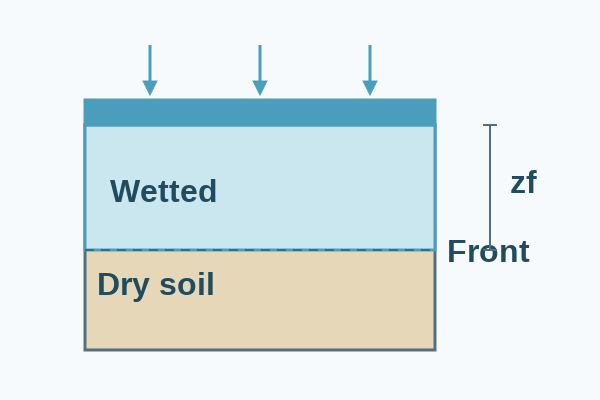
Green–Ampt — ponded infiltration and wetting front

Groundwater & Seepage, Unsaturated Soil Hydraulics

By Foundation Design Method Library

88 Rank #176 Views 1,567
Workspace
QUICK ACCESS
Related engineering apps Cases & data

App-specific engineering geometry and parameter schematic

Theory and Method

\documentclass[11pt]{article} \usepackage{amsmath,amssymb,geometry,xurl,hyperref} \geometry{margin=0.85in} \setlength{\emergencystretch}{3em} \begin{document} \section{Green-Ampt - ponded infiltration and wetting front} \subsection{Purpose} Integrate the Green-Ampt piston-front idealization for soil that is ponded from time zero. A bounded Newton solution finds cumulative infiltration, then Darcy flow gives the current capacity and the front depth. \subsection{Method and governing equations} \[ A=\psi_f(\theta_s-\theta_i),\qquad f=K_s\left(1+\frac{A}{F}\right) \] \[ K_st=F-A\ln\left(1+\frac{F}{A}\right),\qquad z_f=\frac{F}{\theta_s-\theta_i} \] \subsection{Inputs, symbols and units} \begin{itemize} \item \textbf{Saturated hydraulic conductivity} ($\mathtt{Ks}$): mm/hour. Default 10. \item \textbf{Wetting-front suction head} ($\mathtt{psi}$): mm. Default 100. \item \textbf{Volumetric moisture deficit} ($\mathtt{dtheta}$): m3/m3. Default 0.2. \item \textbf{Elapsed time since continuous ponding} ($\mathtt{t}$): hour. Default 1. \end{itemize} \subsection{Interpreting the results} Use the front depth to inspect a single ponded event within a uniform layer. If rainfall is less than infiltration capacity, this calculation does not determine actual infiltration; a rainfall-limited event model is required. \subsection{Worked default example} \begin{itemize} \item Cumulative infiltration: 27.15353348 mm. \item Current infiltration capacity: 17.36552391 mm/hour. \item Wetting-front depth: 135.7676674 mm. \end{itemize} \subsection{Verification example} For A = 20 mm and K = 10 mm/hour, choosing t = 2(1 - ln 2) hours makes the implicit equation's exact solution F = A = 20 mm. The verification case changes the following default inputs; all other inputs retain the defaults listed above. \begin{itemize} \item $\mathtt{t}=0.6137056389$: hour. \end{itemize} Expected benchmark quantities: \begin{itemize} \item Cumulative infiltration: 20. \item Current infiltration capacity: 20. \item Wetting-front depth: 100. \end{itemize} \subsection{Assumptions and limits} A homogeneous profile, constant initial moisture deficit and negligible surface ponding depth are assumed. Water supply is unlimited for the stated period. The clock starts at continuous ponding, so rainfall-to-ponding transitions, runoff routing, redistribution and layered soils are not represented. Positive time, suction and deficit avoid the singular initial infiltration rate. \subsection{References} USACE HEC-HMS Technical Reference Manual, Green and Ampt Loss Model. Basic concepts: piston wetting front, moisture deficit, suction and saturated conductivity. \url{https://www.hec.usace.army.mil/confluence/hmsdocs/hmstrm/canopy-surface-infiltration-and-runoff-volume/infiltration/green-and-ampt-loss-model} The app derives and integrates Darcy flow for continuously ponded soil. It does not implement the entire HEC-HMS rainfall-runoff model. \end{document}

Engineering Calculator

Engineering Calculation Results