Hvorslev — long-screen overdamped slug test

Groundwater & Seepage, Pumping and Slug Tests

By Foundation Design Method Library

270 Rank #72 Views 6,510
Workspace
QUICK ACCESS
Related engineering apps Cases & data

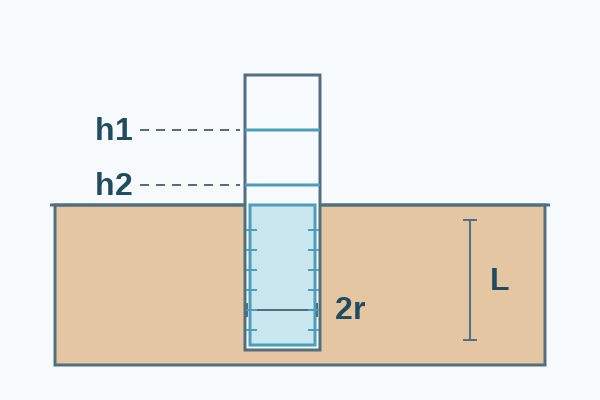
App-specific engineering geometry and parameter schematic

Theory and Method

\documentclass[11pt]{article} \usepackage{amsmath,amssymb,geometry,xurl,hyperref} \geometry{margin=0.85in} \setlength{\emergencystretch}{3em} \begin{document} \section{Hvorslev - long-screen overdamped slug test} \subsection{Purpose} Reduce the exponential portion of a nonoscillatory slug-test response to hydraulic conductivity using the long-screen Hvorslev shape approximation. Residual heads are measured relative to the equilibrium water level. \subsection{Method and governing equations} \[ K=\frac{r_c^2\ln(L/r_s)}{2L(t_2-t_1)}\ln\left(\frac{h_1}{h_2}\right) \] \[ t_0=\frac{t_2-t_1}{\ln(h_1/h_2)} \] \subsection{Inputs, symbols and units} \begin{itemize} \item \textbf{Inner radius of standpipe or casing} ($\mathtt{rc}$): m. Default 0.025. \item \textbf{Effective screened bore radius} ($\mathtt{rs}$): m. Default 0.05. \item \textbf{Effective screen length} ($\mathtt{L}$): m. Default 2. \item \textbf{First positive residual-head magnitude} ($\mathtt{h1}$): m. Default 0.2. \item \textbf{Later positive residual-head magnitude} ($\mathtt{h2}$): m. Default 0.1. \item \textbf{Time between the two readings} ($\mathtt{dt}$): s. Default 60. \end{itemize} \subsection{Interpreting the results} Select readings from the linear portion of a log residual-head versus time plot. A two-point estimate is useful for a check; a regression over several suitable readings is preferable for a reported field interpretation. \subsection{Worked default example} \begin{itemize} \item Estimated hydraulic conductivity: 0.000006658688524 m/s. \item Exponential recovery time constant: 86.56170245 s. \item Semilog recovery decay rate: 0.01155245301 1/s. \end{itemize} \subsection{Verification example} The stored benchmark is an independently evaluated identity or worked numerical case, not a value copied from the runtime output. The verification case changes the following default inputs; all other inputs retain the defaults listed above. \begin{itemize} \item $\mathtt{rc}=0.05$: m. \item $\mathtt{rs}=0.05$: m. \item $\mathtt{L}=1$: m. \item $\mathtt{h1}=0.1$: m. \item $\mathtt{h2}=0.03678794412$: m. \item $\mathtt{dt}=100$: s. \end{itemize} Expected benchmark quantities: \begin{itemize} \item Estimated hydraulic conductivity: 0.00003744665342. \item Exponential recovery time constant: 100. \end{itemize} \subsection{Assumptions and limits} The screen is fully submerged and L/rs is at least 8. The formation is homogeneous and isotropic and elastic aquifer storage is neglected. Use magnitudes of residual head from one monotonic recovery branch. Well skin, filter-pack storage, water-table crossing, very early inertial data and oscillatory tests are not represented. \subsection{References} The Groundwater Project, Methods to Interpret Overdamped Slug Tests. Section 14.4, Hvorslev method; long-screen shape approximation also shown in Solution Exercise 7. \url{https://books.gw-project.org/an-introduction-to-hydraulic-testing-in-hydrogeology/chapter/methods-to-interpret-overdamped-slug-tests/} Quasi-steady, nonoscillatory response of a long screened interval; elastic storage and inertial effects are omitted. \end{document}

Engineering Calculator

Engineering Calculation Results