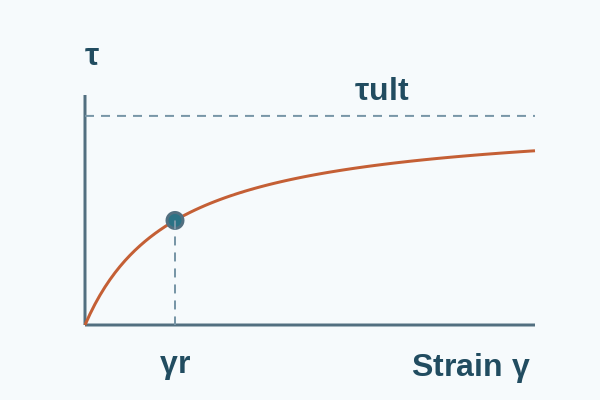
Hyperbolic soil backbone — strain-dependent stiffness

Geotechnical Earthquake Engineering, Dynamic Soil Properties

By Foundation Design Method Library

90 Rank #173 Views 1,192
Workspace
QUICK ACCESS
Related engineering apps Cases & data

App-specific engineering geometry and parameter schematic

Theory and Method

\documentclass[11pt]{article} \usepackage{amsmath,amssymb,geometry,xurl,hyperref} \geometry{margin=0.85in} \setlength{\emergencystretch}{3em} \begin{document} \section{Hyperbolic soil backbone - strain-dependent stiffness} \subsection{Purpose} Inspect a basic hyperbolic shear stress-strain backbone and distinguish secant from tangent stiffness. Reference strain follows from the selected small-strain modulus and asymptotic shear stress. \subsection{Method and governing equations} \[ \gamma_r=\frac{\tau_{\mathrm{ult}}}{G_{\max}},\qquad \tau=\frac{G_{\max}\gamma}{1+\gamma/\gamma_r} \] \[ \frac{G_{\mathrm{sec}}}{G_{\max}}=\frac1{1+\gamma/\gamma_r},\qquad G_{\mathrm{tan}}=\frac{G_{\max}}{(1+\gamma/\gamma_r)^2} \] \subsection{Inputs, symbols and units} \begin{itemize} \item \textbf{Small-strain shear modulus} ($\mathtt{Gmax}$): MPa. Default 100. \item \textbf{Asymptotic shear stress in fitted backbone} ($\mathtt{tauult}$): kPa. Default 100. \item \textbf{Shear-strain amplitude} ($\mathtt{gammapct}$): percent. Default 0.1. \end{itemize} \subsection{Interpreting the results} Compare the predicted backbone with measured modulus-reduction and strength data across the intended strain range. At the reference strain the secant modulus is half Gmax, while the tangent is one-quarter Gmax. \subsection{Worked default example} \begin{itemize} \item Secant shear-modulus ratio G/Gmax: 0.5 -. \item Secant shear modulus: 50 MPa. \item Tangent shear modulus: 25 MPa. \item Backbone shear stress: 50 kPa. \item Reference shear strain: 0.1 percent. \end{itemize} \subsection{Verification example} The stored benchmark is an independently evaluated identity or worked numerical case, not a value copied from the runtime output. The verification case uses the default inputs listed above. Expected benchmark quantities: \begin{itemize} \item Secant shear-modulus ratio G/Gmax: 0.5. \item Secant shear modulus: 50. \item Tangent shear modulus: 25. \item Backbone shear stress: 50. \item Reference shear strain: 0.1. \end{itemize} \subsection{Assumptions and limits} This monotonic backbone is a fitted constitutive idealization for nonnegative strain amplitude. Gmax and tauult must be compatible with the material, effective confinement and loading conditions. The app does not calculate hysteretic damping, strain accumulation, pore-pressure generation, cyclic degradation or equivalent-linear site response. A stress asymptote is not a design strength selected independently of the test conditions. \subsection{References} Hardin and Drnevich (1972), Shear Modulus and Damping in Soils: Design Equations and Curves. Hyperbolic shear stress-strain backbone and reference strain. \url{https://doi.org/10.1061/JSFEAQ.0001760} Only the basic hyperbolic backbone is implemented; no damping calibration, cyclic degradation or site-response iteration. \end{document}

Engineering Calculator

Engineering Calculation Results