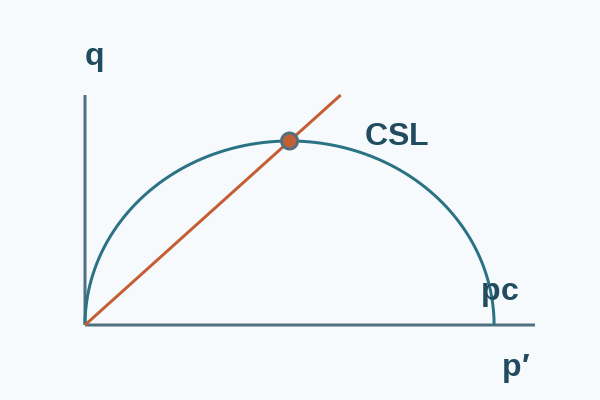
Modified Cam-Clay — yield ellipse and stiffness state

Laboratory & Site Characterization, Critical-State Soil Mechanics

By Foundation Design Method Library

201 Rank #104 Views 3,826
Workspace
QUICK ACCESS
Related engineering apps Cases & data

App-specific engineering geometry and parameter schematic

Theory and Method

\documentclass[11pt]{article} \usepackage{amsmath,amssymb,geometry,xurl,hyperref} \geometry{margin=0.85in} \setlength{\emergencystretch}{3em} \begin{document} \section{Modified Cam-Clay - yield ellipse and stiffness state} \subsection{Purpose} Inspect a selected effective stress point against a Modified Cam-Clay yield ellipse and calculate the current volumetric stiffness and hardening parameters. The critical-state line and the ellipse are shown as distinct constraints. \subsection{Method and governing equations} \[ f=q^2+M^2p(p-p_c),\qquad f_{\mathrm{norm}}=\frac{f}{M^2p_c^2} \] \[ q_y=M\sqrt{p(p_c-p)}\quad (0\leq p\leq p_c),\qquad q_{\mathrm{CSL}}=Mp \] \[ K=\frac{(1+e)p}{\kappa},\qquad \frac{dp_c}{d\epsilon_v^p}=\frac{(1+e)p_c}{\lambda-\kappa} \] \subsection{Inputs, symbols and units} \begin{itemize} \item \textbf{Mean effective stress p; compression positive} ($\mathtt{p}$): kPa. Default 100. \item \textbf{Deviatoric stress magnitude q} ($\mathtt{q}$): kPa. Default 120. \item \textbf{Isotropic preconsolidation pressure pc} ($\mathtt{pc}$): kPa. Default 200. \item \textbf{Critical-state stress ratio M} ($\mathtt{M}$): -. Default 1.2. \item \textbf{Current void ratio} ($\mathtt{e0}$): -. Default 1. \item \textbf{Isotropic normal-compression slope lambda} ($\mathtt{lam}$): -. Default 0.2. \item \textbf{Isotropic swelling slope kappa} ($\mathtt{kap}$): -. Default 0.04. \end{itemize} \subsection{Interpreting the results} A negative yield function lies inside the elastic domain, zero is on the current yield surface, and positive is outside it. An outside point calls for constitutive integration or a revised state; it is not a factor of safety. \subsection{Worked default example} \begin{itemize} \item Normalized yield function; positive is outside: 0 -. \item Yield-ellipse q boundary at selected p: 120 kPa. \item Critical-state-line q at selected p: 120 kPa. \item Current elastic tangent bulk modulus: 5000 kPa. \item Preconsolidation hardening modulus dpc/depsilon-v-plastic: 2500 kPa. \end{itemize} \subsection{Verification example} At p = pc/2 = 100 kPa and M = 1.2, the ellipse reaches its top q = M pc/2 = 120 kPa, exactly on the critical-state line. The verification case uses the default inputs listed above. Expected benchmark quantities: \begin{itemize} \item Normalized yield function; positive is outside: 0. \item Yield-ellipse q boundary at selected p: 120. \item Critical-state-line q at selected p: 120. \item Current elastic tangent bulk modulus: 5000. \item Preconsolidation hardening modulus dpc/depsilon-v-plastic: 2500. \end{itemize} \subsection{Assumptions and limits} p is compression-positive and q is nonnegative. pc is an isotropic model yield pressure, not automatically the vertical oedometer preconsolidation stress. Lambda and kappa are slopes in specific volume versus natural-log mean effective stress. No stress update, plastic return mapping, strain prediction, tensile strength or finite-element analysis is performed. If p exceeds pc, no nonnegative q lies inside this ellipse; the reported q boundary is zero and the positive yield function identifies that state. \subsection{References} Itasca, Modified Cam-Clay Model: Formulations. Equations 15 and 18, tangent bulk modulus and yield ellipse. \url{https://docs.itascacg.com/itasca950/common/models/camclay/doc/modelcamclay.html} A state-point and parameter check, not an incremental constitutive integration or finite-element calculation. \end{document}

Engineering Calculator

Engineering Calculation Results