Pressuremeter — corrected pseudo-elastic modulus

Laboratory & Site Characterization, Dilatometer and Pressuremeter

By Foundation Design Method Library

246 Rank #85 Views 2,751
Workspace
QUICK ACCESS
Related engineering apps Cases & data

App-specific engineering geometry and parameter schematic

Theory and Method

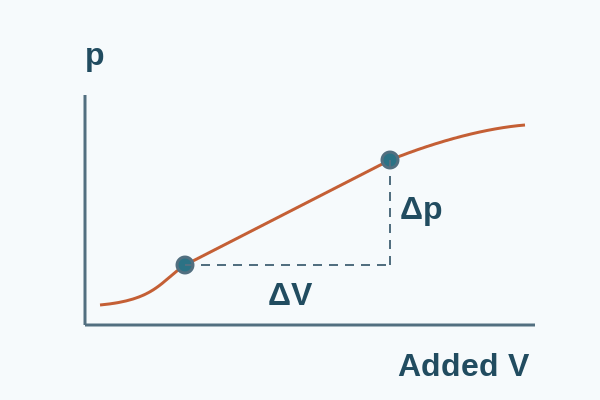
\documentclass[11pt]{article} \usepackage{amsmath,amssymb,geometry,xurl,hyperref} \geometry{margin=0.85in} \setlength{\emergencystretch}{3em} \begin{document} \section{Pressuremeter - corrected pseudo-elastic modulus} \subsection{Purpose} Evaluate the pseudo-elastic pressuremeter modulus from two points on a selected corrected loading segment. Added volumes are measured from the initial cell volume, so V0 plus their average gives the representative expanded volume. \subsection{Method and governing equations} \[ E_M=2(1+\nu)(V_0+V_m)\frac{\Delta p}{\Delta V},\qquad V_m=\frac{V_1+V_2}{2} \] \subsection{Inputs, symbols and units} \begin{itemize} \item \textbf{Initial measuring-cell volume} ($\mathtt{V0}$): cm3. Default 500. \item \textbf{Corrected added volume at first point} ($\mathtt{V1}$): cm3. Default 0. \item \textbf{Corrected added volume at second point} ($\mathtt{V2}$): cm3. Default 100. \item \textbf{Corrected pressure at first point} ($\mathtt{p1}$): kPa. Default 100. \item \textbf{Corrected pressure at second point} ($\mathtt{p2}$): kPa. Default 200. \item \textbf{Assumed Poisson ratio} ($\mathtt{nu}$): -. Default 0.25. \end{itemize} \subsection{Interpreting the results} Retain the selected points and the entire test curve. Use EM in a method calibrated for the same pressuremeter procedure and strain level, rather than silently substituting it for an unrelated stiffness. \subsection{Worked default example} \begin{itemize} \item Pressuremeter modulus EM: 1375 kPa. \item Apparent cavity shear modulus: 550 kPa. \item Corrected pressure-volume slope: 1 kPa/cm3. \end{itemize} \subsection{Verification example} The stored benchmark is an independently evaluated identity or worked numerical case, not a value copied from the runtime output. The verification case uses the default inputs listed above. Expected benchmark quantities: \begin{itemize} \item Pressuremeter modulus EM: 1375. \item Apparent cavity shear modulus: 550. \item Corrected pressure-volume slope: 1. \end{itemize} \subsection{Assumptions and limits} The interval must be an appropriate pseudo-elastic part of a corrected pressure-volume response. Instrument expansion, membrane pressure, tubing compliance and head corrections are prerequisites. This loading EM is not automatically the small-strain Young's modulus. An unload-reload modulus needs a separate, consistently signed interval and interpretation; creep and limit pressure are not inferred. \subsection{References} FHWA GEC 5, Geotechnical Site Characterization (2016). FHWA GEC 5, section 8.9.3, equation 8.19 and Figure 8-16.. \url{https://highways.dot.gov/sites/fhwa.dot.gov/files/FHWA-NHI-16-072.pdf} Data reduction and explicitly calibrated correlations; these tools do not replace soil sampling, local validation or a complete site investigation. \end{document}

Engineering Calculator

Engineering Calculation Results