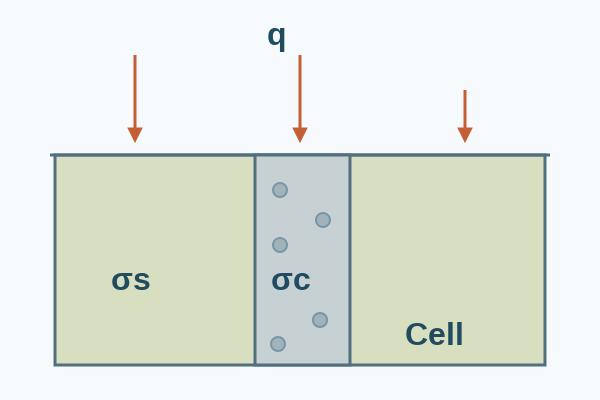
Stone columns — unit-cell stress sharing

Soil Improvement, Aggregate Columns

By Foundation Design Method Library

163 Rank #122 Views 2,021
Workspace
QUICK ACCESS
Related engineering apps Cases & data

App-specific engineering geometry and parameter schematic

Theory and Method

\documentclass[11pt]{article} \usepackage{amsmath,amssymb,geometry,xurl,hyperref} \geometry{margin=0.85in} \setlength{\emergencystretch}{3em} \begin{document} \section{Stone columns - unit-cell stress sharing} \subsection{Purpose} Determine how a supplied stress concentration ratio distributes an average vertical load between an aggregate column and its surrounding soil. The calculation enforces vertical-force equilibrium over one tributary cell. \subsection{Method and governing equations} \[ a_r=\frac{A_c}{A_{\mathrm{cell}}},\qquad n=\frac{\sigma_c}{\sigma_s} \] \[ q=a_r\sigma_c+(1-a_r)\sigma_s,\qquad \sigma_s=\frac{q}{1+(n-1)a_r} \] \[ \sigma_c=n\sigma_s,\qquad Q_c=A_c\sigma_c \] \subsection{Inputs, symbols and units} \begin{itemize} \item \textbf{Installed stone-column diameter} ($\mathtt{D}$): m. Default 0.8. \item \textbf{Tributary unit-cell area} ($\mathtt{Acell}$): m2. Default 4. \item \textbf{Column-to-soil stress concentration ratio} ($\mathtt{n}$): -. Default 3. \item \textbf{Average applied vertical stress} ($\mathtt{q}$): kPa. Default 100. \end{itemize} \subsection{Interpreting the results} Use the stresses as inputs to separately justified column and matrix checks. Increasing the assumed n transfers more load into the column, so it must not be treated as an automatic improvement without a capacity and compatibility assessment. \subsection{Worked default example} \begin{itemize} \item Column area replacement ratio: 0.1256637061 -. \item Average stress in surrounding soil: 79.91513573 kPa. \item Average column stress: 239.7454072 kPa. \item Column load per cell: 120.5091856 kN. \item Column share of total cell load: 0.301272964 -. \end{itemize} \subsection{Verification example} The stored benchmark is an independently evaluated identity or worked numerical case, not a value copied from the runtime output. The verification case changes the following default inputs; all other inputs retain the defaults listed above. \begin{itemize} \item $\mathtt{D}=1.128379167$: m. \item $\mathtt{Acell}=4$: m2. \item $\mathtt{n}=3$: -. \item $\mathtt{q}=100$: kPa. \end{itemize} Expected benchmark quantities: \begin{itemize} \item Column area replacement ratio: 0.25. \item Average stress in surrounding soil: 66.66666667. \item Average column stress: 200. \item Column load per cell: 200. \item Column share of total cell load: 0.5. \end{itemize} \subsection{Assumptions and limits} The column is represented by its installed circular area. The stress ratio is a calibrated input, not a prediction from elastic modulus alone. FHWA notes dependence on soil, construction, spacing, blanket, time and loading rigidity. The app does not check bulging, punching, group capacity, global stability or settlement compatibility. \subsection{References} FHWA GEC 13, Ground Modification Methods Reference Manual, Volume I (2016). FHWA GEC 13 Volume I, section 4.1.2 of the aggregate-column chapter, equations 5-2 through 5-5.. \url{https://highways.dot.gov/sites/fhwa.dot.gov/files/FHWA-NHI-16-027.pdf} Preliminary analytical quantities require site calibration, construction controls and the other limit-state checks described in the manual. \end{document}

Engineering Calculator

Engineering Calculation Results