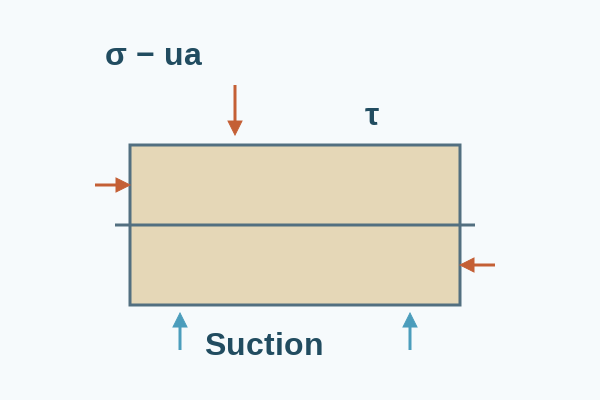
Unsaturated shear strength — net stress and suction

Laboratory & Site Characterization, Unsaturated Soil Strength

By Foundation Design Method Library

106 Rank #152 Views 2,158
Workspace
QUICK ACCESS
Related engineering apps Cases & data

App-specific engineering geometry and parameter schematic

Theory and Method

\documentclass[11pt]{article} \usepackage{amsmath,amssymb,geometry,xurl,hyperref} \geometry{margin=0.85in} \setlength{\emergencystretch}{3em} \begin{document} \section{Unsaturated shear strength - net stress and suction} \subsection{Purpose} Separate the contributions of net normal stress and matric suction in a locally calibrated unsaturated-soil shear-strength envelope. This permits a transparent check of strength loss when suction reduces. \subsection{Method and governing equations} \[ \tau_f=c'+(\sigma-u_a)\tan\phi'+(u_a-u_w)\tan\phi^b \] \subsection{Inputs, symbols and units} \begin{itemize} \item \textbf{Effective cohesion intercept} ($\mathtt{c}$): kPa. Default 5. \item \textbf{Effective friction angle} ($\mathtt{phi}$): deg. Default 30. \item \textbf{Suction friction angle phi-b} ($\mathtt{phi\_b}$): deg. Default 15. \item \textbf{Net normal stress sigma minus ua} ($\mathtt{sigma\_net}$): kPa. Default 100. \item \textbf{Matric suction ua minus uw} ($\mathtt{suction}$): kPa. Default 50. \end{itemize} \subsection{Interpreting the results} Compare dry-weather and wetting scenarios with measured parameters. The suction contribution can disappear during wetting; retain a separate saturated assessment where loss of suction is credible. \subsection{Worked default example} \begin{itemize} \item Predicted shear strength: 76.13248654 kPa. \item Net-stress friction contribution: 57.73502692 kPa. \item Suction strength contribution: 13.39745962 kPa. \end{itemize} \subsection{Verification example} The stored benchmark is an independently evaluated identity or worked numerical case, not a value copied from the runtime output. The verification case changes the following default inputs; all other inputs retain the defaults listed above. \begin{itemize} \item $\mathtt{c}=5$: kPa. \item $\mathtt{phi}=45$: deg. \item $\mathtt{phi\_b}=45$: deg. \item $\mathtt{sigma\_net}=100$: kPa. \item $\mathtt{suction}=20$: kPa. \end{itemize} Expected benchmark quantities: \begin{itemize} \item Predicted shear strength: 125. \item Suction strength contribution: 20. \end{itemize} \subsection{Assumptions and limits} Both input stress variables are nonnegative. A constant phi-b is a local approximation and must not be extrapolated beyond the suction range of testing. The app enforces phi-b no greater than phi-prime for its intended common-soil envelope. No unsaturated slope equilibrium, retention coupling or rainfall transient is solved. \subsection{References} Fredlund, Morgenstern and Widger (1978), The shear strength of unsaturated soils. Two independent stress-state variables and the phi-b strength expression. \url{https://doi.org/10.1139/t78-029} A locally calibrated planar strength envelope; a constant phi-b is not valid over an unlimited suction range. \end{document}

Engineering Calculator

Engineering Calculation Results