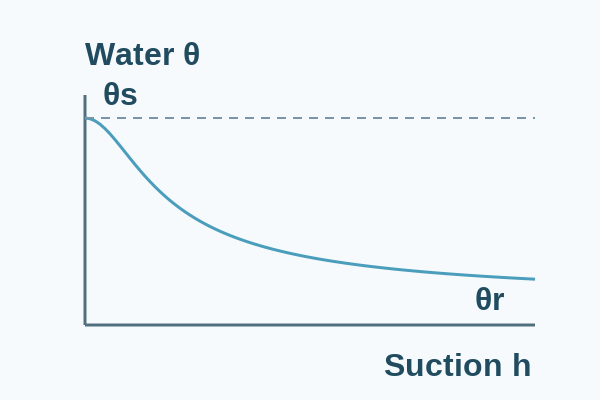
van Genuchten — soil-water retention

Groundwater & Seepage, Unsaturated Soil Hydraulics

By Foundation Design Method Library

194 Rank #106 Views 4,304
Workspace
QUICK ACCESS
Related engineering apps Cases & data

App-specific engineering geometry and parameter schematic

Theory and Method

\documentclass[11pt]{article} \usepackage{amsmath,amssymb,geometry,xurl,hyperref} \geometry{margin=0.85in} \setlength{\emergencystretch}{3em} \begin{document} \section{van Genuchten - soil-water retention} \subsection{Purpose} Convert a measured or assumed suction head into water content using a fitted van Genuchten retention curve. The effective saturation measures the fraction of the drainable water-content range that remains filled. \subsection{Method and governing equations} \[ m=1-\frac1n,\qquad S_e=[1+(\alpha h)^n]^{-m} \] \[ \theta=\theta_r+(\theta_s-\theta_r)S_e \] \subsection{Inputs, symbols and units} \begin{itemize} \item \textbf{Residual volumetric water content} ($\mathtt{theta\_r}$): m3/m3. Default 0.05. \item \textbf{Saturated volumetric water content} ($\mathtt{theta\_s}$): m3/m3. Default 0.45. \item \textbf{Inverse air-entry scale alpha} ($\mathtt{alpha}$): 1/m. Default 1. \item \textbf{Pore-size shape parameter n} ($\mathtt{n}$): -. Default 2. \item \textbf{Positive suction-head magnitude} ($\mathtt{h}$): m. Default 1. \end{itemize} \subsection{Interpreting the results} Use the water content to inspect a calibrated retention curve or obtain an initial moisture state for a separate flow model. At zero suction the result is theta\_s; at large suction it approaches theta\_r. \subsection{Worked default example} \begin{itemize} \item Effective saturation: 0.7071067812 -. \item Volumetric water content: 0.3328427125 m3/m3. \item Retention exponent m: 0.5 -. \end{itemize} \subsection{Verification example} The stored benchmark is an independently evaluated identity or worked numerical case, not a value copied from the runtime output. The verification case uses the default inputs listed above. Expected benchmark quantities: \begin{itemize} \item Effective saturation: 0.7071067812. \item Volumetric water content: 0.3328427125. \item Retention exponent m: 0.5. \end{itemize} \subsection{Assumptions and limits} Use positive suction magnitude h, not a signed pore-pressure head. Parameters must come from the relevant wetting or drying branch; hysteresis, air entrapment, temperature and volume change are omitted. The m = 1 - 1/n restriction is part of this implementation. Retention alone does not predict infiltration or slope stability. \subsection{References} van Genuchten (1980), A Closed-form Equation for Predicting the Hydraulic Conductivity of Unsaturated Soils. Water-retention and Mualem conductivity equations; restriction m = 1 - 1/n. \url{https://doi.org/10.2136/sssaj1980.03615995004400050002x} Fitted retention and conductivity constitutive curves; no Richards-equation or site-calibration solver. \end{document}

Engineering Calculator

Engineering Calculation Results