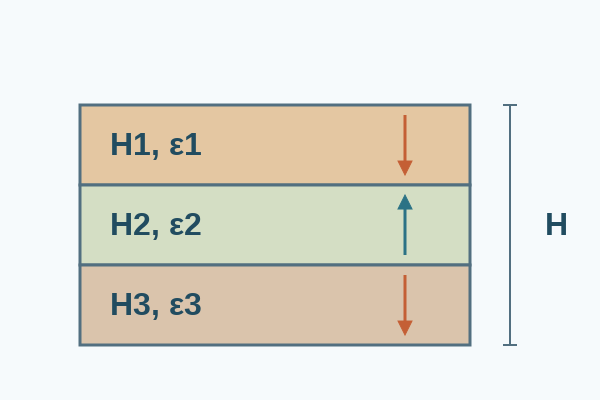
Wetting movement — layered collapse and heave

Shallow Foundation, Problematic Soils

By Foundation Design Method Library

264 Rank #75 Views 5,844
Workspace
QUICK ACCESS
Related engineering apps Cases & data

App-specific engineering geometry and parameter schematic

Theory and Method

\documentclass[11pt]{article} \usepackage{amsmath,amssymb,geometry,xurl,hyperref} \geometry{margin=0.85in} \setlength{\emergencystretch}{3em} \begin{document} \section{Wetting movement - layered collapse and heave} \subsection{Purpose} Convert measured one-dimensional wetting strains into vertical movement over a selected wetting depth. Separate compressive and expansive contributions so cancellation in the net movement remains visible. \subsection{Method and governing equations} \[ \Delta H_i=H_i\epsilon_{\mathrm{wet},i},\qquad S_{\mathrm{net}}=\sum_i\Delta H_i \] \[ S_{\mathrm{collapse}}=\sum_i\max(0,\Delta H_i),\qquad H_{\mathrm{heave}}=\sum_i\max(0,-\Delta H_i) \] \subsection{Inputs, symbols and units} \begin{itemize} \item \textbf{Layer 1 wetted thickness} ($\mathtt{H1}$): m. Default 2. \item \textbf{Layer 1 wetting strain; compression positive} ($\mathtt{eps1}$): percent. Default 1.5. \item \textbf{Layer 2 wetted thickness} ($\mathtt{H2}$): m. Default 3. \item \textbf{Layer 2 wetting strain; compression positive} ($\mathtt{eps2}$): percent. Default 1. \item \textbf{Layer 3 wetted thickness} ($\mathtt{H3}$): m. Default 1. \item \textbf{Layer 3 wetting strain; compression positive} ($\mathtt{eps3}$): percent. Default 0.5. \end{itemize} \subsection{Interpreting the results} Compare the individual layer movements as well as their sum. A net value near zero can conceal large opposing movements or differential effects if the wetting pattern varies laterally. \subsection{Worked default example} \begin{itemize} \item Net wetting movement; downward positive: 65 mm. \item Sum of compressive wetting movements: 65 mm. \item Sum of expansive wetting movements: 0 mm. \item Layer 1 movement: 30 mm. \item Layer 2 movement: 30 mm. \item Layer 3 movement: 5 mm. \end{itemize} \subsection{Verification example} The stored benchmark is an independently evaluated identity or worked numerical case, not a value copied from the runtime output. The verification case changes the following default inputs; all other inputs retain the defaults listed above. \begin{itemize} \item $\mathtt{H1}=1$: m. \item $\mathtt{eps1}=-1$: percent. \item $\mathtt{H2}=2$: m. \item $\mathtt{eps2}=2$: percent. \item $\mathtt{H3}=3$: m. \item $\mathtt{eps3}=0$: percent. \end{itemize} Expected benchmark quantities: \begin{itemize} \item Net wetting movement; downward positive: 30. \item Sum of compressive wetting movements: 40. \item Sum of expansive wetting movements: 10. \end{itemize} \subsection{Assumptions and limits} Strains must be measured or independently established at the stress, water-content path and wetting condition relevant to each layer. Positive strain denotes compression and negative strain denotes expansion. Only the thickness expected to undergo that wetting change is entered. The tool does not estimate collapse or swell strain from soil classification, predict suction change or capture three-dimensional soil-structure interaction. \subsection{References} FHWA NHI-06-088, Soils and Foundations Reference Manual, Volume I (2006). One-dimensional consolidation, compressibility and problematic soil behavior. \url{https://www.fhwa.dot.gov/engineering/geotech/pubs/nhi06088.pdf} Constant-coefficient consolidation and strain summation are applied only within their stated physical limits. \end{document}

Engineering Calculator

Engineering Calculation Results