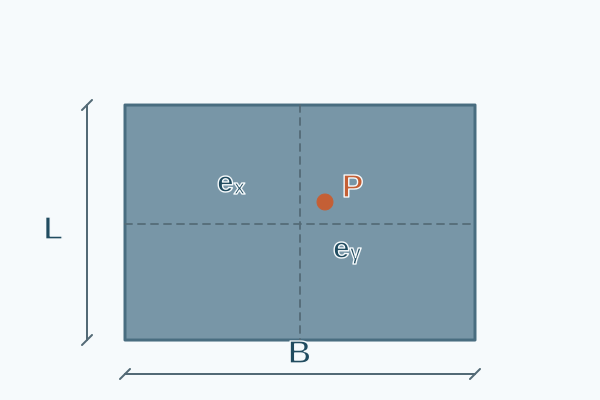
Rectangular footing — biaxial eccentric contact stresses

Shallow Foundation, Bearing Capacity

By Foundation Design Method Library

231 Rank #91 Views 2,774
Workspace
QUICK ACCESS
Related engineering apps Cases & data

App-specific engineering geometry and parameter schematic

Theory and Method

\documentclass[11pt]{article} \usepackage{amsmath,amssymb,longtable,hyperref} \begin{document} \section{Rectangular footing -- biaxial eccentric contact stresses} \subsection{Application and idealization} Service-level linear elastic bearing-contact pressure for a rigid rectangular foundation with simultaneous moments about perpendicular plan axes. \subsection{Governing equations} \[ e_B=|M_y|/P,\quad e_L=|M_x|/P \] \[ q_{\max,\min}=\frac{P}{BL}\left(1\pm\frac{6e_B}{B}\pm\frac{6e_L}{L}\right) \] \subsection{Inputs, symbols and units} \begin{longtable}{p{0.16\linewidth}p{0.42\linewidth}p{0.12\linewidth}p{0.18\linewidth}} Symbol & Meaning & Unit & Default \\ B & Footing width & m & 2.4 \\ L & Footing length & m & 3.6 \\ P & Axial service load & kN & 1250 \\ Mx & Moment about the width axis & kN\(\cdot\)m & 140 \\ My & Moment about the length axis & kN\(\cdot\)m & 95 \\ qa & Permissible contact pressure & kPa & 250 \\ \end{longtable} \subsection{Calculation procedure} \[ A = B\,L \] \[ \mathrm{qavg} = \frac{P}{A} \] \[ \mathrm{ex} = \left|\frac{\mathrm{My}}{P}\right| \] \[ \mathrm{ey} = \left|\frac{\mathrm{Mx}}{P}\right| \] \[ \mathrm{qmax} = \mathrm{qavg}\,\left(1+\frac{6\,\mathrm{ex}}{B}+\frac{6\,\mathrm{ey}}{L}\right) \] \[ \mathrm{qmin} = \mathrm{qavg}\,\left(1-\frac{6\,\mathrm{ex}}{B}-\frac{6\,\mathrm{ey}}{L}\right) \] \[ U = \frac{\mathrm{qmax}}{\mathrm{qa}} \] \begin{itemize} \item Average pressure: \( \mathrm{qavg} \). \item Biaxial maximum contact pressure: \( \mathrm{qmax} \). \item Biaxial minimum contact pressure: \( \mathrm{qmin} \). \item Eccentricity across width: \( \mathrm{ex} \). \item Eccentricity across length: \( \mathrm{ey} \). \item Allowable-pressure utilization: \( U \). \end{itemize} \subsection{Worked example using default inputs} \begin{itemize} \item Average pressure: 144.67593 kPa. \item Biaxial maximum contact pressure: 199.17052 kPa. \item Biaxial minimum contact pressure: 90.181327 kPa. \item Eccentricity across width: 0.076 m. \item Eccentricity across length: 0.112 m. \item Allowable-pressure utilization: 0.7966821. \item Contact-pressure check: Within specified allowable. \end{itemize} \subsection{Assumptions and interpretation} Entire rectangular footing remains in compression only when the biaxial diamond-kern condition 6|e\_B|/B + 6|e\_L|/L \(\leq\) 1 holds. No tension, nonlinear contact, or settlement redistribution; specified allowable pressure must be established separately. \subsection{Accepted input ranges} \begin{itemize} \item Footing width: 0.2 to 60 m. \item Footing length: 0.2 to 60 m. \item Axial service load: 1 to 10000000 kN. \item Moment about the width axis: -10000000 to 10000000 kN\(\cdot\)m. \item Moment about the length axis: -10000000 to 10000000 kN\(\cdot\)m. \item Permissible contact pressure: 1 to 100000 kPa. \end{itemize} \subsection{Reference and scope} FHWA Geotechnical Engineering Circular No. 6, Shallow Foundations (2002). \url{https://www.fhwa.dot.gov/engineering/geotech/pubs/010943.pdf} Shallow-foundation and serviceability background; the app is a bounded implementation of its stated idealization. \end{document}

Engineering Calculator

Engineering Calculation Results