Plate load test — secant subgrade reaction modulus

Shallow Foundation, Settlement

By Foundation Design Method Library

224 Rank #93 Views 5,421
Workspace
QUICK ACCESS
Related engineering apps Cases & data

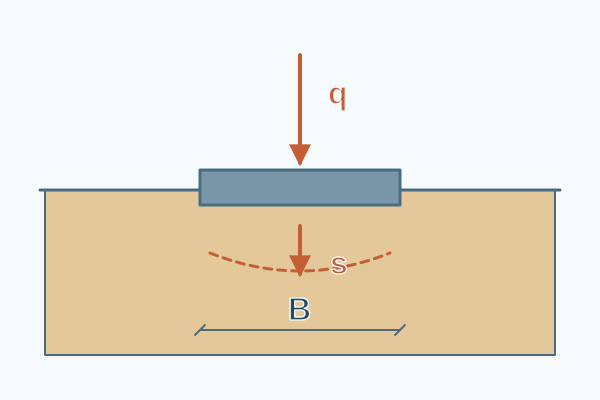
App-specific engineering geometry and parameter schematic

Theory and Method

\documentclass[11pt]{article} \usepackage{amsmath,amssymb,longtable,hyperref} \begin{document} \section{Plate load test -- secant subgrade reaction modulus} \subsection{Application and idealization} Reduce two observed plate-load test readings to a secant reaction coefficient and interpolate within the test interval. \subsection{Governing equations} \[ k_s=\frac{q_2-q_1}{(s_2-s_1)/1000} \] \[ s(q)=s_1+\frac{1000(q-q_1)}{k_s} \] \subsection{Inputs, symbols and units} \begin{longtable}{p{0.16\linewidth}p{0.42\linewidth}p{0.12\linewidth}p{0.18\linewidth}} Symbol & Meaning & Unit & Default \\ q1 & First test plate pressure & kPa & 70 \\ q2 & Second test plate pressure & kPa & 210 \\ s1 & First measured settlement & mm & 1.8 \\ s2 & Second measured settlement & mm & 6.4 \\ qdesign & Target service pressure & kPa & 140 \\ \end{longtable} \subsection{Calculation procedure} \[ \mathrm{dq} = \mathrm{q2}-\mathrm{q1} \] \[ \mathrm{ds} = \frac{\mathrm{s2}-\mathrm{s1}}{1000} \] \[ \mathrm{ks} = \frac{\mathrm{dq}}{\mathrm{ds}} \] \[ \mathrm{sdesign} = \mathrm{s1}+\frac{\mathrm{qdesign}-\mathrm{q1}}{\mathrm{ks}}\,1000 \] \begin{itemize} \item Secant modulus of subgrade reaction: \( \mathrm{ks} \). \item Secant pressure increment: \( \mathrm{dq} \). \item Settlement increment: \( \mathrm{ds}\,1000 \). \item Interpolated test-plate settlement: \( \mathrm{sdesign} \). \end{itemize} \subsection{Worked example using default inputs} \begin{itemize} \item Secant modulus of subgrade reaction: 30434.783 kN/m\(^{3}\). \item Secant pressure increment: 140 kPa. \item Settlement increment: 4.6 mm. \item Interpolated test-plate settlement: 4.1 mm. \end{itemize} \subsection{Assumptions and interpretation} The regression is between TWO plate test readings only. Applies to the specific plate and stress range. Do not apply the same k directly to a full-size foundation without scale and stratigraphy assessment. The target pressure must be inside the measured pressure interval; extrapolation is rejected. \subsection{Accepted input ranges} \begin{itemize} \item First test plate pressure: 0 to 3000 kPa. \item Second test plate pressure: 0 to 3000 kPa. \item First measured settlement: 0 to 200 mm. \item Second measured settlement: 0 to 200 mm. \item Target service pressure: 0 to 3000 kPa. \end{itemize} \subsection{Reference and scope} FHWA Geotechnical Engineering Circular No. 6, Shallow Foundations (2002). \url{https://www.fhwa.dot.gov/engineering/geotech/pubs/010943.pdf} Shallow-foundation and serviceability background; the app is a bounded implementation of its stated idealization. \end{document}

Engineering Calculator

Engineering Calculation Results