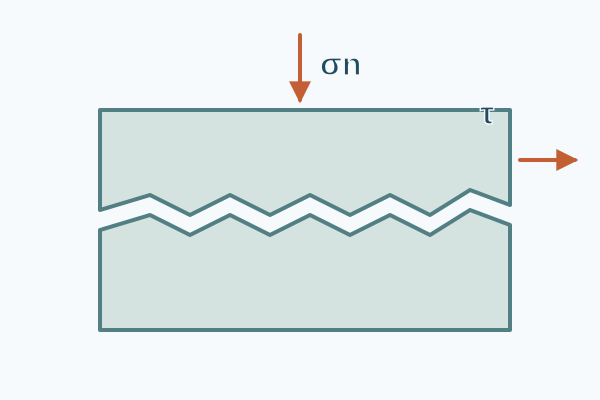
Barton joint criterion — roughness-dependent peak shear

Rock Engineering, Discontinuity Strength

By Foundation Design Method Library

30 Rank #231 Views 376
Workspace
QUICK ACCESS
Related engineering apps Cases & data

App-specific engineering geometry and parameter schematic

Theory and Method

\documentclass[11pt]{article} \usepackage{amsmath,amssymb,geometry,xurl,hyperref} \geometry{margin=0.85in} \setlength{\emergencystretch}{3em} \begin{document} \section{Barton joint criterion - roughness-dependent peak shear} \subsection{Purpose} Evaluate rough-joint peak shear resistance for supplied scale-appropriate roughness and joint-wall strength. \subsection{Governing equations} \[ \tau=\sigma'_n\tan\left[\phi_b+JRC\log_{10}\left(\frac{JCS}{\sigma'_n}\right)\right] \] \subsection{Inputs and units} \begin{itemize} \item \textbf{Effective normal stress on joint} ($\mathtt{sn}$): MPa. Default 0.5. \item \textbf{Joint-wall compressive strength} ($\mathtt{JCS}$): MPa. Default 50. \item \textbf{Joint roughness coefficient} ($\mathtt{JRC}$): -. Default 8. \item \textbf{Basic friction angle} ($\mathtt{phib}$): degrees. Default 28. \end{itemize} \subsection{How to use the result} Enter values on the stated measurement and unit basis. Intermediate quantities are calculated in the order shown in the downloadable method. Interpret the reported quantities within the physical assumptions below. \begin{itemize} \item Apparent peak friction angle: degrees. \item Peak joint shear resistance: MPa. \end{itemize} \subsection{Worked default example} \begin{itemize} \item Apparent peak friction angle: 44 degrees. \item Peak joint shear resistance: 0.482844387 MPa. \end{itemize} \subsection{Verification example} A separate hand-checkable or limiting-case benchmark uses the following inputs: \begin{itemize} \item $\mathtt{sn}=1$: MPa. \item $\mathtt{JCS}=10$: MPa. \item $\mathtt{JRC}=0$: -. \item $\mathtt{phib}=45$: degrees. \end{itemize} Expected benchmark quantities: \begin{itemize} \item Apparent peak friction angle: 45. \item Peak joint shear resistance: 1. \end{itemize} \subsection{Assumptions and limits} Original basic-friction form for unweathered joints. Use effective compression, matching stress units and field-scale JRC/JCS. The apparent angle is limited to 70 degrees. Filled, weathered or already sheared joints require a separately selected residual or infill model. \subsection{Reference} Hoek, Practical Rock Engineering, chapter 4: Shear strength of discontinuities (2023). \url{https://static.rocscience.cloud/assets/resources/learning/hoek/4.-Shear-strength-of-discontinuities_2023-06-30-120608_pbkx.pdf} Basic-friction Barton criterion for unweathered joints and its practical stress/angle limits. The residual-friction modification is a different parameter basis. \end{document}

Engineering Calculator

Engineering Calculation Results