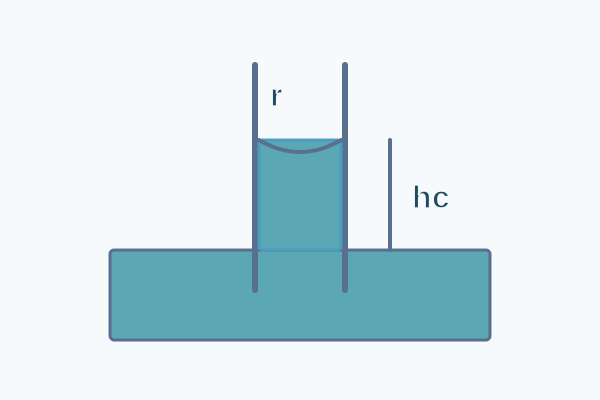
Capillary tube — theoretical rise and suction

Groundwater & Seepage, Unsaturated Soil

By Foundation Design Method Library

173 Rank #114 Views 2,666
Workspace
QUICK ACCESS
Related engineering apps Cases & data

App-specific engineering geometry and parameter schematic

Theory and Method

\documentclass[11pt]{article} \usepackage{amsmath,amssymb,geometry,xurl,hyperref} \geometry{margin=0.85in} \setlength{\emergencystretch}{3em} \begin{document} \section{Capillary tube - theoretical rise and suction} \subsection{Purpose} Relate a selected ideal pore radius to capillary suction and rise using surface-tension equilibrium. \subsection{Governing equations} \[ p_c=\frac{2T\cos\theta}{r},\quad h_c=\frac{p_c}{\gamma_w} \] \subsection{Inputs and units} \begin{itemize} \item \textbf{Equivalent pore-tube radius} ($\mathtt{r}$): mm. Default 0.05. \item \textbf{Water-air surface tension} ($\mathtt{surface}$): N/m. Default 0.0728. \item \textbf{Contact angle} ($\mathtt{theta}$): degrees. Default 0. \end{itemize} \subsection{How to use the result} Enter values on the stated measurement and unit basis. Intermediate quantities are calculated in the order shown in the downloadable method. Interpret the reported quantities within the physical assumptions below. \begin{itemize} \item Capillary pressure difference: kPa. \item Ideal capillary rise: m. \end{itemize} \subsection{Worked default example} \begin{itemize} \item Capillary pressure difference: 2.912 kPa. \item Ideal capillary rise: 0.296941361 m. \end{itemize} \subsection{Verification example} A separate hand-checkable or limiting-case benchmark uses the following inputs: \begin{itemize} \item $\mathtt{r}=0.1$: mm. \item $\mathtt{surface}=0.05$: N/m. \item $\mathtt{theta}=0$: degrees. \end{itemize} Expected benchmark quantities: \begin{itemize} \item Capillary pressure difference: 1. \item Ideal capillary rise: 0.101971621. \end{itemize} \subsection{Assumptions and limits} A pore tube is an idealization; natural soil pore networks, hysteresis, contact-angle variability and air entry require measured retention curves. This is not a soil-specific capillary-height prediction. \subsection{Reference} USACE EM 1110-2-1901, Seepage Analysis and Control for Dams. \url{https://www.publications.usace.army.mil/Portals/76/Publications/EngineerManuals/EM_1110-2-1901.pdf} Head, anisotropy, seepage and drain/filter concepts; project-specific filter criteria must be selected. \end{document}

Engineering Calculator

Engineering Calculation Results