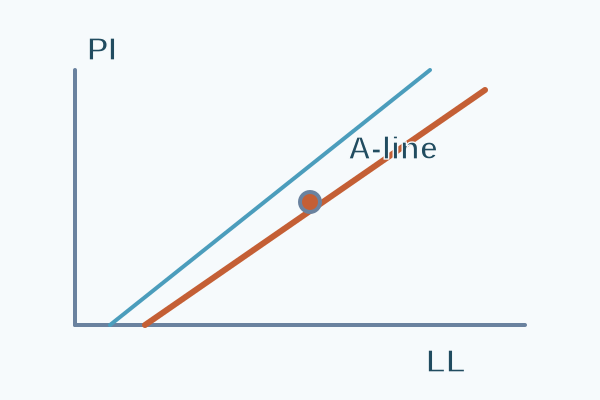
Clay activity — plasticity index normalized by clay fraction

Laboratory & Site Characterization, Soil Classification

By Foundation Design Method Library

22 Rank #238 Views 310
Workspace
QUICK ACCESS
Related engineering apps Cases & data

App-specific engineering geometry and parameter schematic

Theory and Method

\documentclass[11pt]{article} \usepackage{amsmath,amssymb,geometry,xurl,hyperref} \geometry{margin=0.85in} \setlength{\emergencystretch}{3em} \begin{document} \section{Clay activity - plasticity index normalized by clay fraction} \subsection{Purpose} Compute the activity ratio used to compare plasticity with the measured clay-size fraction. \subsection{Governing equations} \[ A=\frac{PI}{\text{percentage by mass finer than }2\,\mu m} \] \subsection{Inputs and units} \begin{itemize} \item \textbf{Plasticity index} ($\mathtt{PI}$): \%. Default 24. \item \textbf{Dry mass finer than 2 micrometers} ($\mathtt{clay}$): \%. Default 30. \end{itemize} \subsection{How to use the result} Enter values on the stated measurement and unit basis. Intermediate quantities are calculated in the order shown in the downloadable method. Interpret the reported quantities within the physical assumptions below. \begin{itemize} \item Clay activity: -. \end{itemize} \subsection{Worked default example} \begin{itemize} \item Clay activity: 0.8 -. \end{itemize} \subsection{Verification example} A separate hand-checkable or limiting-case benchmark uses the following inputs: \begin{itemize} \item $\mathtt{PI}=24$: \%. \item $\mathtt{clay}=30$: \%. \end{itemize} Expected benchmark quantities: \begin{itemize} \item Clay activity: 0.8. \end{itemize} \subsection{Assumptions and limits} Use the less-than-2-micrometer fraction, not total silt-plus-clay fines. Activity is an index and does not identify mineralogy or directly predict swelling pressure. \subsection{Reference} FHWA NHI-06-088, Soils and Foundations Reference Manual, Volume I (2006). \url{https://www.fhwa.dot.gov/engineering/geotech/pubs/nhi06088.pdf} Soil phase relations, stress transformations, laboratory data reduction, soil classification and consolidation. Equations are implemented independently; this application is not an FHWA product. \end{document}

Engineering Calculator

Engineering Calculation Results