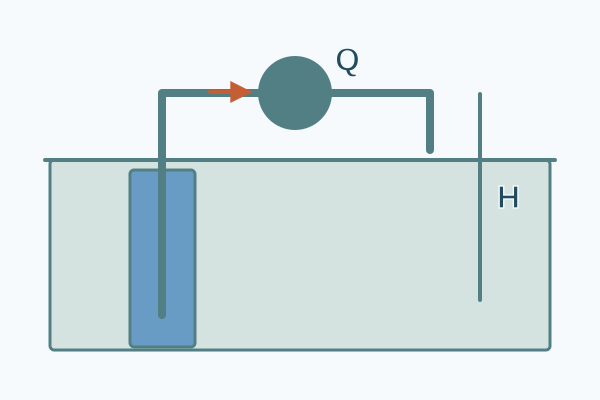
Dewatering pump — hydraulic power and energy allowance

Groundwater & Seepage, Pumping & Dewatering

By Foundation Design Method Library

72 Rank #194 Views 1,465
Workspace
QUICK ACCESS
Related engineering apps Cases & data

App-specific engineering geometry and parameter schematic

Theory and Method

\documentclass[11pt]{article} \usepackage{amsmath,amssymb,geometry,xurl,hyperref} \geometry{margin=0.85in} \setlength{\emergencystretch}{3em} \begin{document} \section{Dewatering pump - hydraulic power and energy allowance} \subsection{Purpose} Estimate continuous power and energy requirements for a selected dewatering duty point. \subsection{Governing equations} \[ P_h=\gamma_wQH,\quad P_e=P_h/\eta,\quad E=P_et \] \subsection{Inputs and units} \begin{itemize} \item \textbf{Pumping discharge} ($\mathtt{Q}$): L/s. Default 20. \item \textbf{Total dynamic head} ($\mathtt{H}$): m. Default 15. \item \textbf{Combined pump and motor efficiency} ($\mathtt{eta}$): \%. Default 65. \item \textbf{Operating duration} ($\mathtt{hours}$): hours. Default 168. \end{itemize} \subsection{How to use the result} Enter values on the stated measurement and unit basis. Intermediate quantities are calculated in the order shown in the downloadable method. Interpret the reported quantities within the physical assumptions below. \begin{itemize} \item Hydraulic power: kW. \item Estimated electrical input: kW. \item Operating energy: kWh. \end{itemize} \subsection{Worked default example} \begin{itemize} \item Hydraulic power: 2.941995 kW. \item Estimated electrical input: 4.52614615 kW. \item Operating energy: 760.392554 kWh. \end{itemize} \subsection{Verification example} A separate hand-checkable or limiting-case benchmark uses the following inputs: \begin{itemize} \item $\mathtt{Q}=10$: L/s. \item $\mathtt{H}=10$: m. \item $\mathtt{eta}=50$: \%. \item $\mathtt{hours}=10$: hours. \end{itemize} Expected benchmark quantities: \begin{itemize} \item Hydraulic power: 0.980665. \item Estimated electrical input: 1.96133. \item Operating energy: 19.6133. \end{itemize} \subsection{Assumptions and limits} Total dynamic head must include lift, pressure and friction losses. Supply efficiency for the actual duty point; starting current, standby capacity and variable operating cycles are not modeled. \subsection{Reference} FHWA HEC-22, Urban Drainage Design Manual, Fourth Edition. \url{https://www.fhwa.dot.gov/engineering/hydraulics/pubs/hif24006.pdf} Continuity and Manning uniform-flow hydraulic sizing concepts. \end{document}

Engineering Calculator

Engineering Calculation Results