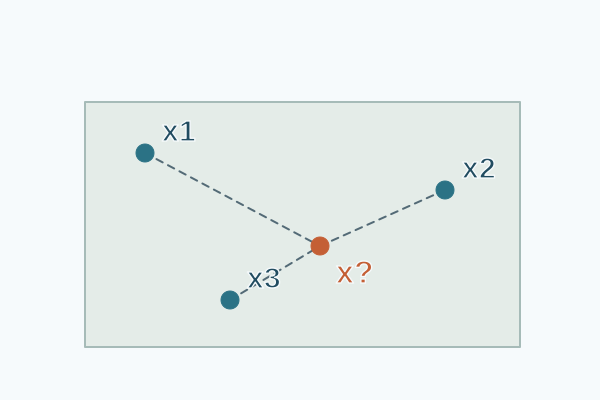
Ground model — inverse-distance estimate from three tests

Geotechnical Data Analysis, Spatial Interpolation

By Foundation Design Method Library

24 Rank #237 Views 589
Workspace
QUICK ACCESS
Related engineering apps Cases & data

App-specific engineering geometry and parameter schematic

Theory and Method

\documentclass[11pt]{article} \usepackage{amsmath,amssymb,geometry,xurl,hyperref} \geometry{margin=0.85in} \setlength{\emergencystretch}{3em} \begin{document} \section{Ground model - inverse-distance estimate from three tests} \subsection{Purpose} Interpolate a scalar property from three nearby tests with an explicit inverse-distance weighting rule. \subsection{Governing equations} \[ \hat v=\frac{\sum_i v_i d_i^{-p}}{\sum_i d_i^{-p}} \] \subsection{Inputs and units} \begin{itemize} \item \textbf{First observed property} ($\mathtt{v1}$): property units. Default 10. \item \textbf{Second observed property} ($\mathtt{v2}$): property units. Default 20. \item \textbf{Third observed property} ($\mathtt{v3}$): property units. Default 30. \item \textbf{Distance to first test} ($\mathtt{d1}$): m. Default 10. \item \textbf{Distance to second test} ($\mathtt{d2}$): m. Default 10. \item \textbf{Distance to third test} ($\mathtt{d3}$): m. Default 10. \item \textbf{Distance exponent} ($\mathtt{p}$): -. Default 2. \end{itemize} \subsection{How to use the result} Enter values on the stated measurement and unit basis. Intermediate quantities are calculated in the order shown in the downloadable method. Interpret the reported quantities within the physical assumptions below. \begin{itemize} \item Interpolated property: property units. \end{itemize} \subsection{Worked default example} \begin{itemize} \item Interpolated property: 20 property units. \end{itemize} \subsection{Verification example} A separate hand-checkable or limiting-case benchmark uses the following inputs: \begin{itemize} \item $\mathtt{v1}=10$: property units. \item $\mathtt{v2}=20$: property units. \item $\mathtt{v3}=30$: property units. \item $\mathtt{d1}=10$: m. \item $\mathtt{d2}=10$: m. \item $\mathtt{d3}=10$: m. \item $\mathtt{p}=2$: -. \end{itemize} Expected benchmark quantities: \begin{itemize} \item Interpolated property: 20. \end{itemize} \subsection{Assumptions and limits} At an observation location the exact local value is returned; coincident observations are averaged. IDW does not account for stratigraphic barriers or quantify prediction uncertainty. \subsection{Reference} Shepard (1968), A two-dimensional interpolation function for irregularly-spaced data. \url{https://doi.org/10.1145/800186.810616} Original inverse-distance interpolation reference. This tool applies the normalized inverse-distance rule to three supplied observations and distances. \end{document}

Engineering Calculator

Engineering Calculation Results