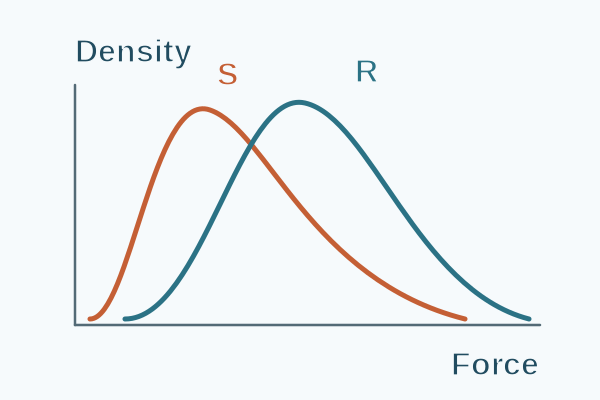
Resistance–demand model — lognormal reliability index

Geotechnical Data Analysis, Reliability

By Foundation Design Method Library

100 Rank #162 Views 2,445
Workspace
QUICK ACCESS
Related engineering apps Cases & data

App-specific engineering geometry and parameter schematic

Theory and Method

\documentclass[11pt]{article} \usepackage{amsmath,amssymb,geometry,xurl,hyperref} \geometry{margin=0.85in} \setlength{\emergencystretch}{3em} \begin{document} \section{Resistance-demand model - lognormal reliability index} \subsection{Purpose} Calculate the reliability index for positive lognormal resistance and demand by transforming the ratio limit state to normal log space. \subsection{Governing equations} \[ \sigma_{\ln X}^2=\ln(1+COV_X^2),\quad \mu_{\ln X}=\ln\mu_X-\tfrac12\sigma_{\ln X}^2 \] \[ \beta=\frac{\mu_{\ln R}-\mu_{\ln S}}{\sqrt{\sigma_{\ln R}^2+\sigma_{\ln S}^2-2\rho_{\ln}\sigma_{\ln R}\sigma_{\ln S}}} \] \subsection{Inputs and units} \begin{itemize} \item \textbf{Arithmetic mean resistance} ($\mathtt{muR}$): kN. Default 150. \item \textbf{Arithmetic mean demand} ($\mathtt{muS}$): kN. Default 100. \item \textbf{Resistance coefficient of variation} ($\mathtt{covR}$): -. Default 0.2. \item \textbf{Demand coefficient of variation} ($\mathtt{covS}$): -. Default 0.15. \item \textbf{Correlation between natural-log variables} ($\mathtt{rhoLog}$): -. Default 0. \end{itemize} \subsection{How to use the result} Enter values on the stated measurement and unit basis. Intermediate quantities are calculated in the order shown in the downloadable method. Interpret the reported quantities within the physical assumptions below. \begin{itemize} \item Mean logarithmic safety margin: -. \item Log-margin standard deviation: -. \item Lognormal reliability index beta: -. \end{itemize} \subsection{Worked default example} \begin{itemize} \item Mean logarithmic safety margin: 0.396980056 -. \item Log-margin standard deviation: 0.247934108 -. \item Lognormal reliability index beta: 1.60115145 -. \end{itemize} \subsection{Verification example} A separate hand-checkable or limiting-case benchmark uses the following inputs: \begin{itemize} \item $\mathtt{muR}=100$: kN. \item $\mathtt{muS}=100$: kN. \item $\mathtt{covR}=0.2$: -. \item $\mathtt{covS}=0.2$: -. \item $\mathtt{rhoLog}=0$: -. \end{itemize} Expected benchmark quantities: \begin{itemize} \item Mean logarithmic safety margin: 0. \item Lognormal reliability index beta: 0. \end{itemize} \subsection{Assumptions and limits} The correlation input is between ln(R) and ln(S), not their arithmetic values. Distribution choice and model uncertainty require independent justification. \subsection{Reference} NIST/SEMATECH, Lognormal Distribution. \url{https://www.itl.nist.gov/div898/handbook/eda/section3/eda3669.htm} Lognormal moments and transformation between arithmetic and natural-log parameters. \end{document}

Engineering Calculator

Engineering Calculation Results