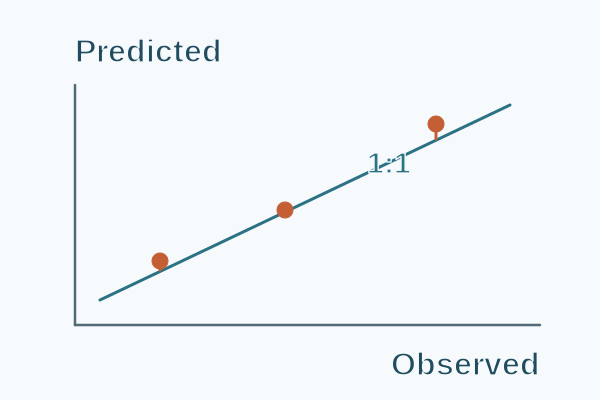
Geotechnical prediction — RMSE, MAE and signed bias

Geotechnical Data Analysis, Model Benchmarks

By Foundation Design Method Library

48 Rank #207 Views 623
Workspace
QUICK ACCESS
Related engineering apps Cases & data

App-specific engineering geometry and parameter schematic

Theory and Method

\documentclass[11pt]{article} \usepackage{amsmath,amssymb,geometry,xurl,hyperref} \geometry{margin=0.85in} \setlength{\emergencystretch}{3em} \begin{document} \section{Geotechnical prediction - RMSE, MAE and signed bias} \subsection{Purpose} Compare three held-out geotechnical predictions with their observations using complementary error summaries. \subsection{Governing equations} \[ RMSE=\sqrt{\frac1n\sum(\hat y_i-y_i)^2},\quad MAE=\frac1n\sum|\hat y_i-y_i| \] \subsection{Inputs and units} \begin{itemize} \item \textbf{First observed value} ($\mathtt{o1}$): property units. Default 10. \item \textbf{Second observed value} ($\mathtt{o2}$): property units. Default 20. \item \textbf{Third observed value} ($\mathtt{o3}$): property units. Default 30. \item \textbf{First prediction} ($\mathtt{p1}$): property units. Default 11. \item \textbf{Second prediction} ($\mathtt{p2}$): property units. Default 18. \item \textbf{Third prediction} ($\mathtt{p3}$): property units. Default 33. \end{itemize} \subsection{How to use the result} Enter values on the stated measurement and unit basis. Intermediate quantities are calculated in the order shown in the downloadable method. Interpret the reported quantities within the physical assumptions below. \begin{itemize} \item Root mean square error: property units. \item Mean absolute error: property units. \item Signed prediction bias: property units. \end{itemize} \subsection{Worked default example} \begin{itemize} \item Root mean square error: 2.1602469 property units. \item Mean absolute error: 2 property units. \item Signed prediction bias: 0.666666667 property units. \end{itemize} \subsection{Verification example} A separate hand-checkable or limiting-case benchmark uses the following inputs: \begin{itemize} \item $\mathtt{o1}=10$: property units. \item $\mathtt{o2}=20$: property units. \item $\mathtt{o3}=30$: property units. \item $\mathtt{p1}=11$: property units. \item $\mathtt{p2}=18$: property units. \item $\mathtt{p3}=33$: property units. \end{itemize} Expected benchmark quantities: \begin{itemize} \item Root mean square error: 2.1602469. \item Mean absolute error: 2. \item Signed prediction bias: 0.666666667. \end{itemize} \subsection{Assumptions and limits} Positive bias means overprediction. Keep training and testing independent and preserve units; a three-row check illustrates metrics but cannot establish out-of-site generalization. \subsection{Reference} NIST/SEMATECH e-Handbook of Statistical Methods. \url{https://www.itl.nist.gov/div898/handbook/} Standard statistical identities. Geotechnical interpretation, spatial dependence and design criteria remain application-specific. \end{document}

Engineering Calculator

Engineering Calculation Results