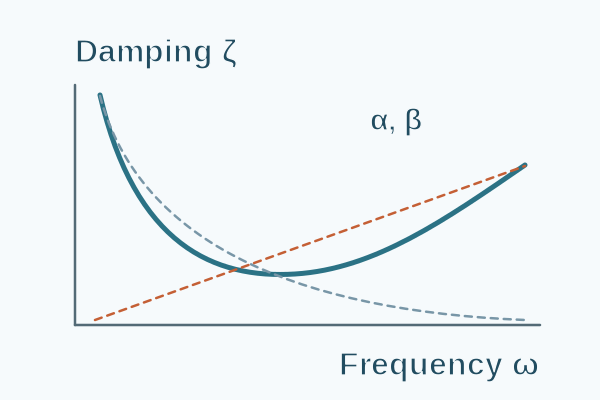
Rayleigh damping — coefficients for two target frequencies

Geotechnical Earthquake Engineering, Numerical Model Parameters

By Foundation Design Method Library

35 Rank #225 Views 666
Workspace
QUICK ACCESS
Related engineering apps Cases & data

App-specific engineering geometry and parameter schematic

Theory and Method

\documentclass[11pt]{article} \usepackage{amsmath,amssymb,geometry,xurl,hyperref} \geometry{margin=0.85in} \setlength{\emergencystretch}{3em} \begin{document} \section{Rayleigh damping - coefficients for two target frequencies} \subsection{Purpose} Solve for the two proportional-damping coefficients that match selected damping ratios at two frequencies. \subsection{Governing equations} \[ \zeta(\omega)=\frac{\alpha}{2\omega}+\frac{\beta\omega}{2},\quad C=\alpha M+\beta K \] \subsection{Inputs and units} \begin{itemize} \item \textbf{Lower target frequency} ($\mathtt{f1}$): Hz. Default 1. \item \textbf{Upper target frequency} ($\mathtt{f2}$): Hz. Default 5. \item \textbf{Damping ratio at lower frequency} ($\mathtt{z1}$): -. Default 0.05. \item \textbf{Damping ratio at upper frequency} ($\mathtt{z2}$): -. Default 0.05. \end{itemize} \subsection{How to use the result} Enter values on the stated measurement and unit basis. Intermediate quantities are calculated in the order shown in the downloadable method. Interpret the reported quantities within the physical assumptions below. \begin{itemize} \item Mass-proportional coefficient alpha: 1/s. \item Stiffness-proportional coefficient beta: s. \item Reconstructed lower-frequency damping: -. \item Reconstructed upper-frequency damping: -. \end{itemize} \subsection{Worked default example} \begin{itemize} \item Mass-proportional coefficient alpha: 0.523598776 1/s. \item Stiffness-proportional coefficient beta: 0.00265258238 s. \item Reconstructed lower-frequency damping: 0.05 -. \item Reconstructed upper-frequency damping: 0.05 -. \end{itemize} \subsection{Verification example} A separate hand-checkable or limiting-case benchmark uses the following inputs: \begin{itemize} \item $\mathtt{f1}=0.159154943$: Hz. \item $\mathtt{f2}=0.318309886$: Hz. \item $\mathtt{z1}=0.05$: -. \item $\mathtt{z2}=0.05$: -. \end{itemize} Expected benchmark quantities: \begin{itemize} \item Mass-proportional coefficient alpha: 0.0666666667. \item Stiffness-proportional coefficient beta: 0.0333333333. \item Reconstructed lower-frequency damping: 0.05. \item Reconstructed upper-frequency damping: 0.05. \end{itemize} \subsection{Assumptions and limits} Coefficients depend on the chosen stiffness definition in the solver. Damping outside the target band can be excessive. Negative coefficients are rejected because they can introduce nonphysical energy input. \subsection{Reference} OpenSees, Rayleigh Damping Command. \url{https://opensees.github.io/OpenSeesDocumentation/user/manual/model/damping/rayleigh.html} Mass and stiffness proportional damping definitions. Coefficients here are solved for the selected two frequencies. \end{document}

Engineering Calculator

Engineering Calculation Results