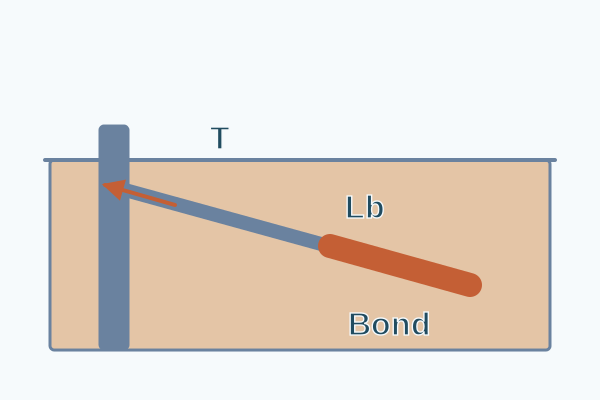
Fully grouted rock bolt — steel and bond capacity limits

Rock Engineering, Rock Reinforcement

By Foundation Design Method Library

118 Rank #144 Views 1,564
Workspace
QUICK ACCESS
Related engineering apps Cases & data

App-specific engineering geometry and parameter schematic

Theory and Method

\documentclass[11pt]{article} \usepackage{amsmath,amssymb,geometry,xurl,hyperref} \geometry{margin=0.85in} \setlength{\emergencystretch}{3em} \begin{document} \section{Fully grouted rock bolt - steel and bond capacity limits} \subsection{Purpose} Compare two basic axial resistance limits of a fully grouted bolt anchoring a defined rock block. \subsection{Governing equations} \[ Q_s=A_sf_y,\quad Q_b=\pi D_hL_b\tau_b,\quad Q_a=\min(Q_s,Q_b)/FS \] \subsection{Inputs and units} \begin{itemize} \item \textbf{Steel bar diameter} ($\mathtt{d}$): mm. Default 25. \item \textbf{Steel yield stress} ($\mathtt{fy}$): MPa. Default 500. \item \textbf{Grout-hole diameter} ($\mathtt{Dh}$): mm. Default 45. \item \textbf{Effective anchored length beyond release surface} ($\mathtt{Lb}$): m. Default 2. \item \textbf{Grout-rock nominal bond stress} ($\mathtt{tau}$): MPa. Default 0.5. \item \textbf{Selected nominal-capacity safety factor} ($\mathtt{FS}$): -. Default 2. \end{itemize} \subsection{How to use the result} Enter values on the stated measurement and unit basis. Intermediate quantities are calculated in the order shown in the downloadable method. Interpret the reported quantities within the physical assumptions below. \begin{itemize} \item Nominal steel tensile yield load: kN. \item Nominal grout-rock bond load: kN. \item Allowable governing load: kN. \item Governing modeled limit: -. \end{itemize} \subsection{Worked default example} \begin{itemize} \item Nominal steel tensile yield load: 245.436926 kN. \item Nominal grout-rock bond load: 141.371669 kN. \item Allowable governing load: 70.6858347 kN. \item Governing modeled limit: Grout-rock bond -. \end{itemize} \subsection{Verification example} A separate hand-checkable or limiting-case benchmark uses the following inputs: \begin{itemize} \item $\mathtt{d}=20$: mm. \item $\mathtt{fy}=400$: MPa. \item $\mathtt{Dh}=40$: mm. \item $\mathtt{Lb}=1$: m. \item $\mathtt{tau}=1$: MPa. \item $\mathtt{FS}=2$: -. \end{itemize} Expected benchmark quantities: \begin{itemize} \item Nominal steel tensile yield load: 125.663706. \item Nominal grout-rock bond load: 125.663706. \item Allowable governing load: 62.8318531. \end{itemize} \subsection{Assumptions and limits} Also check plate, nut, steel-grout bond, corrosion, installation quality and block stability. Effective bond length excludes the moving zone; nominal strengths require test-based selection. \subsection{Reference} Hoek, Practical Rock Engineering (2023). \url{https://static.rocscience.cloud/assets/resources/learning/hoek/Practical-Rock-Engineering-E.Hoek-2023.pdf} Rock testing, discontinuity strength, rock mass characterization and elastic excavation mechanics. \end{document}

Engineering Calculator

Engineering Calculation Results