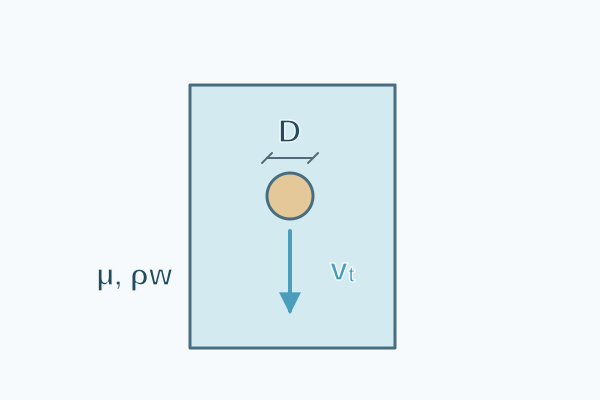
Hydrometer sedimentation — Stokes equivalent diameter

Laboratory & Site Characterization, Particle Size

By Foundation Design Method Library

40 Rank #218 Views 613
Workspace
QUICK ACCESS
Related engineering apps Cases & data

App-specific engineering geometry and parameter schematic

Theory and Method

\documentclass[11pt]{article} \usepackage{amsmath,amssymb,geometry,xurl,hyperref} \geometry{margin=0.85in} \setlength{\emergencystretch}{3em} \begin{document} \section{Hydrometer sedimentation - Stokes equivalent diameter} \subsection{Purpose} Convert a settling depth and elapsed time into an equivalent spherical particle diameter for sedimentation-test interpretation. \subsection{Governing equations} \[ d=\sqrt{\frac{18\mu L}{(\rho_s-\rho_w)gt}} \] \subsection{Inputs and units} \begin{itemize} \item \textbf{Settling distance} ($\mathtt{L}$): cm. Default 10. \item \textbf{Elapsed settling time} ($\mathtt{t}$): min. Default 10. \item \textbf{Water dynamic viscosity} ($\mathtt{mu}$): mPa s. Default 1.002. \item \textbf{Solids specific gravity} ($\mathtt{Gs}$): -. Default 2.65. \end{itemize} \subsection{How to use the result} Enter values on the stated measurement and unit basis. Intermediate quantities are calculated in the order shown in the downloadable method. Interpret the reported quantities within the physical assumptions below. \begin{itemize} \item Equivalent Stokes diameter: mm. \end{itemize} \subsection{Worked default example} \begin{itemize} \item Equivalent Stokes diameter: 0.0136298846 mm. \end{itemize} \subsection{Verification example} A separate hand-checkable or limiting-case benchmark uses the following inputs: \begin{itemize} \item $\mathtt{L}=9.80665$: cm. \item $\mathtt{t}=3$: min. \item $\mathtt{mu}=1$: mPa s. \item $\mathtt{Gs}=2$: -. \end{itemize} Expected benchmark quantities: \begin{itemize} \item Equivalent Stokes diameter: 0.0316227766. \end{itemize} \subsection{Assumptions and limits} Dilute suspension, isolated rigid spheres, laminar terminal settling and water density 1000 kg/m3. Hydrometer meniscus, temperature and dispersant concentration corrections must be applied separately. \subsection{Reference} FHWA NHI-06-088, Soils and Foundations Reference Manual, Volume I (2006). \url{https://www.fhwa.dot.gov/engineering/geotech/pubs/nhi06088.pdf} Soil phase relations, stress transformations, laboratory data reduction, soil classification and consolidation. Equations are implemented independently; this application is not an FHWA product. \end{document}

Engineering Calculator

Engineering Calculation Results